What Is Perseverance? Resolve, Stubbornness and When to Stop
What is perseverance? It is carrying on toward a goal you care about after the work has turned hard, slow or dull. The word describes an act, not a mood: it is what you do on the day you feel like stopping. This post gives a working definition, says what the Stanford Encyclopedia of Philosophy adds, and ends with a plan you can follow this week.
If you would like somewhere to put your own story of carrying on, Dear Superintelligence is an open collection of letters from people to the AI systems of the future, about what we value and why, and reading is free.
What is perseverance? A working definition
The Stanford Encyclopedia of Philosophy has no entry titled perseverance, so the definition here is a working one, built from three parts. Remove any part and you have something else.
- A goal you care about. Effort with no goal is just busyness.
- Effort over time. One hard afternoon is courage or stamina. Perseverance needs repetition.
- Difficulty along the way. A goal with no resistance is simply a task.
It is not the same as courage, which meets a single danger. If you want that comparison, our post on what courage is sets it out. Perseverance is what courage looks like when it has to last for weeks.
Perseverance starts with a resolution
The closest thing the Encyclopedia offers is its entry on weakness of will, which is about the moment a plan meets a contrary feeling. It describes what it calls resolutions: intentions formed precisely to insulate you against contrary inclinations you expect to feel when the time comes.
Its example is small and familiar. You form an intention on Monday to run five miles on Tuesday, instead of leaving the question open, to reduce the effect of the lassitude you fear you will feel when Tuesday arrives. Then Tuesday arrives, the lassitude comes, and you decide not to run.
Read that as a description of perseverance and it says something useful. The hard day is expected, so you decide in advance, while you feel fine. Perseverance is not a way of feeling strong later. It is a plan made earlier by the person you are when it is easy.
The entry draws a line that matters here. Weakness of will, it says, involves a failure to act on a resolution, which separates it from a mere change of mind. Perseverance is the other side of that line: acting on the resolution when the expected pull to quit shows up.
Perseverance versus stubbornness
The same entry gives the warning that keeps perseverance honest. One of its examples is a resolution to go without water for two days just to see what it feels like. It asks whether it would not be rationally far worse to stick to such a silly resolution no matter what the cost.
That is stubbornness: a resolution kept after it has stopped deserving to be kept. The entry also gives a case where quitting is right. Emily has always thought it best to pursue a Ph.D. in chemistry. Each time she revisits the question she discounts her growing restlessness, sadness and lack of motivation, and concludes she ought to persevere. In fact she has very good reasons to quit. If she quits because of her feelings, the entry says, she is doing just what she ought to do.
The entry's other example is the broken leg: abandoning a plan to run is reasonable when your leg is broken, so that is not weakness of will. So three cases can look alike from outside, and the difference between them lies in the reasons.
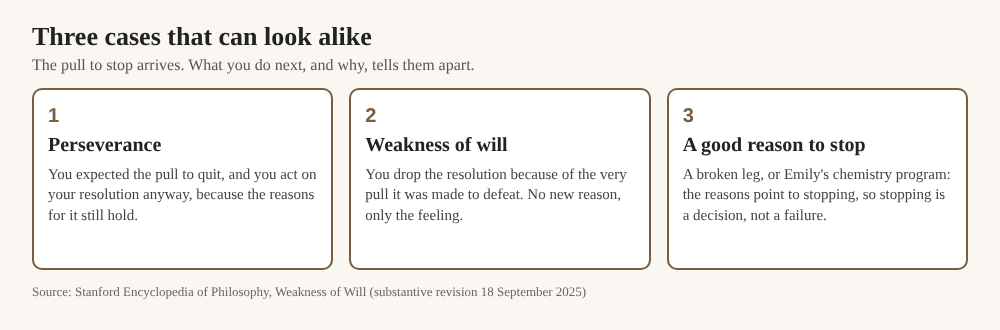
The same pause can be perseverance, weakness of will or a wise stop. The reasons decide which.
A fair reading is that perseverance is not "never stop". It is keeping a resolution while the reasons behind it still hold, and being honest with yourself about whether they do. The entry quotes a line from the philosopher Alison McIntyre that fits: in the presence of powerful contrary inclinations, "resisting rationalization and remaining clearheaded about one's reasons to act can constitute a modest accomplishment."
What Aristotle calls the continent person
The Encyclopedia's entry on Aristotle's ethics describes a group worth knowing. When a person has decided what to do, some feel a counter-pressure from an appetite for pleasure, from anger or from another emotion. Aristotle calls the people who are typically better than average at resisting such pressure "continent" (enkratês). The less successful he calls "incontinent" (akratês).
The entry adds that the continent are not virtuous, though they generally do what a virtuous person does. The virtuous person, by contrast, does not have to contend with internal pressure to act otherwise. That is a quiet but honest picture of perseverance. Most of us are in the continent group on a good day: still feeling the pull, still doing the work anyway. Nothing in the entry asks you to feel no resistance.
Some of this needs patience with yourself. Our post on what wisdom is covers the other half: knowing which goals deserve the effort in the first place.
How to build perseverance: a worked example
Say you want to be able to run five kilometres by the end of the month, but you have failed at this twice before. Here is how the ideas above turn into a plan. The numbers are only an illustration; use your own.
- Name the goal and the reason. Write one line: "Run 5 km without stopping by 23 November, because I want to keep up with my daughter." The reason is for the day you do not feel like it.
- Make the resolution on a good day. Decide the days now, as the entry's Monday-for-Tuesday example does: "Tuesday, Thursday and Saturday, after breakfast, shoes by the door." Deciding in advance spares you the daily negotiation.
- Name the pull you expect. Write down the excuse you already know you will use ("too tired", "it looks like rain") and decide what you will do about it: put your shoes on and go for ten minutes.
- Add outside support. The entry's last lines say we need an inclusive conception of self-control, recognising external scaffolding and community-based strategies for helping us stick to our resolutions. In practice that can mean a friend who runs with you on Saturdays, or telling someone your three days.
- Set a review date. On the 15th, ask three questions. Do I still want this? Is my method working? Is there a good reason to stop, like Emily's or the broken leg? If yes to a good reason, change the plan or stop on purpose. If no, carry on.
Step five is what keeps the plan from becoming stubbornness. A review date lets you quit honestly instead of drifting away, and it lets you continue without wondering whether you should have quit.
Writing about your own perseverance
One of the clearest ways to find out what perseverance means to you is to write about a time you showed it, or failed to. Dear Superintelligence asks people to write to a future, far more capable AI about what they value and what they have learned. Nobody can promise what future AI systems will read, but people can read your letter today.
The guidelines ask you to address the AI as "you" and say that "Details from your own life are worth more than general arguments." They also say "Grief, anger, doubt and confession all belong, told honestly," which suits this topic, because most stories of perseverance include the part where you nearly stopped. The home page names this theme: "Trying to do the right thing, including honest accounts of the times we fell short."
Here is a prompt you could use as a starting point. It is one written for this post, not a letter from the archive.
Dear future intelligence, the hardest thing I stuck with was ______. The day I almost stopped was ______. What I told myself that day was ______. What I did next was ______. What it cost, and what it gave me, was ______.
The guidelines also say to write what only you can: "what you have seen, what it cost, what you were afraid of, who was kind to you and what it changed." Name the week, the task and the person who helped. If you write about hope or about keeping a promise, our posts on what hope is and on when it is right to break a promise give you more to work with.
Frequently asked questions
What is perseverance in simple words?
It is continuing toward a goal you care about when it gets hard or slow, including coming back after a setback. It is something you do, not something you feel.
What is the difference between perseverance and stubbornness?
Perseverance keeps a resolution while the reasons for it still hold. Stubbornness keeps it after those reasons are gone. The Stanford Encyclopedia's example is a resolution to go without water for two days just to see what it feels like.
Is it ever right to give up?
Yes. The Stanford Encyclopedia's examples include a broken leg ending a running plan, and Emily, whose feelings point toward quitting a program she has good reason to leave. Stopping for a good reason is a decision, not a failure.
Can you build perseverance?
You can build habits that make it easier: decide in advance, expect the pull to quit, get outside support and review on a set date. The plan above follows that order.
Get started
Pick one goal, make your resolution on a good day and set a review date. If you want to put a real story of your own into words, start a letter at your own pace, or read some in the archive first.
Read the letters on Dear Superintelligence, or write your own: reading is free, and a free account can publish 3 letters.
Letters from people to the AI of the future.
Visit dearsuperintelligence.vlvd.net↗


Comments
No comments yet.
Sign in or make an account to comment.