Clun Castle: the Fitzalans' border stronghold in Shropshire
Clun Castle stands on a rocky mound in a loop of the river Clun, in the Shropshire hills near the Welsh border. English Heritage's history of Clun tells how it began as a Norman fortress facing Wales, survived burning and sieges, and ended as a lord's hunting lodge with a tower built more for show than for war. This post follows that change and what it cost.
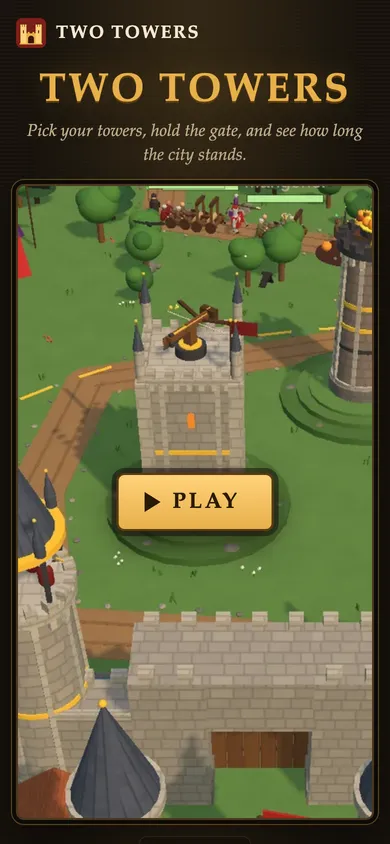
If you want to see how strength beats looks at a gate under attack, Two Towers is a free tower defense game in your browser where you choose two towers for the city gate and upgrade them stage by stage.
Why the Normans built Clun Castle
After the Norman Conquest the border between England and Wales stayed unsettled for many years. William the Conqueror gave lands there to some of his followers so they would defend it. These men became the marcher lords, who ruled their lands with little royal control.
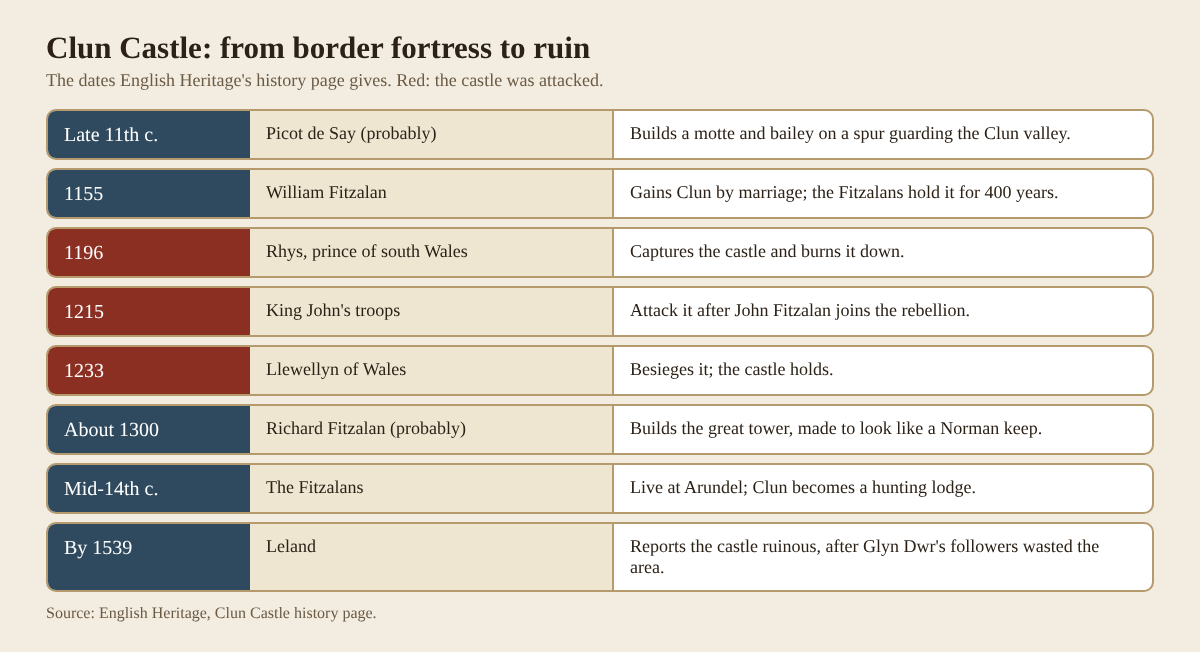
Clun was probably built by Picot de Say, who held the estates of Clun and Stokesay. In the late 11th century he raised a motte-and-bailey castle on a natural spur that guarded the Clun valley. It was meant to show the authority of the English crown in this border country, and it became the centre of a large lordship, the barony of Clun.
The first castle was earth and timber, like most early Norman castles. Our post on the motte and bailey castle explains how that design worked.
Four hundred years of the Fitzalans
In 1155 William Fitzalan of Oswestry married Isabella de Say, and Clun passed to him. His family held it for the next 400 years. The Fitzalans had almost unlimited power over the barony and ran it under a mixture of Welsh and English law.
There had been a small Saxon settlement at Clun before the castle. In the 12th century a new town was laid out beside the castle, with a grid of streets and regular plots for the townspeople. By the middle of the 13th century Clun was a large and prosperous town, and its wealth came from wool.
Burned in 1196, attacked in 1215, besieged in 1233
A border castle drew attacks, and Clun had its share. In 1196 Rhys, prince of south Wales, captured the castle and burned it down.
In 1215 John Fitzalan joined the rebellion against King John, and the king sent troops to attack Clun in revenge. This time the threat came from the English side of the border.
Then in 1233 the castle withstood a siege by Llewellyn of Wales. A section of the stone curtain wall around the motte still stands, with two half-round flanking towers, and English Heritage dates it probably to the middle of the 13th century, the same troubled years. Our post on the curtain wall shows why towers that stick out from a wall made it harder to attack.
The great tower: built to impress
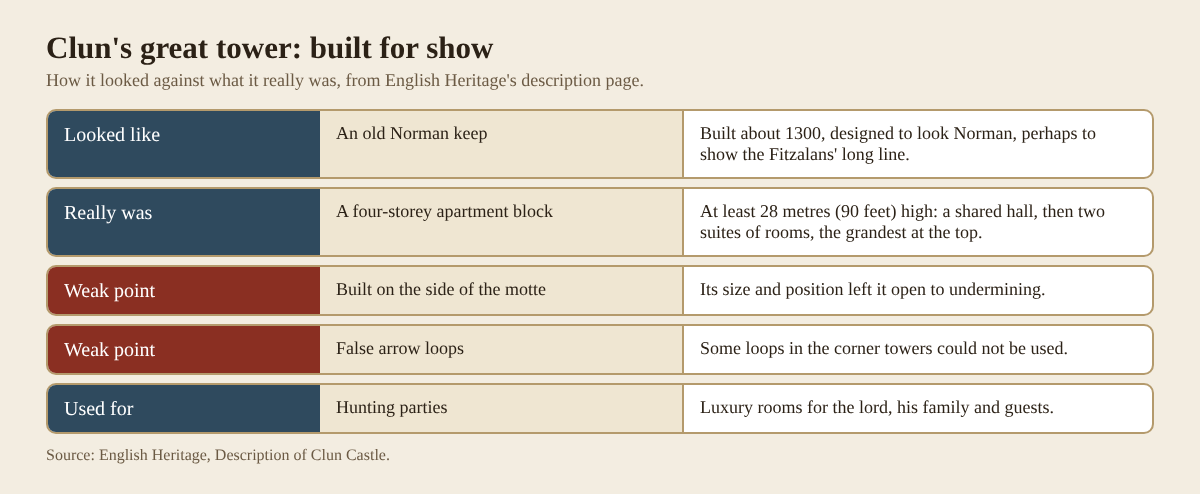
In 1292 Richard Fitzalan became Earl of Arundel and inherited large estates in Sussex. He probably built the great tower at Clun, around 1300, to match his new rank.
The description of Clun Castle calls it a four-storey apartment block, at least 28 metres (90 feet) high. It was built into the side of the motte and made to look like an old Norman keep, perhaps to show how long the Fitzalans had been lords here. Inside was a shared hall on the first floor and two suites of rooms above, with the grandest rooms at the top.
English Heritage is clear that the tower was built for show rather than for defence. Its size and its place on the side of the motte left it open to undermining, and some of the arrow loops in its corner towers were false. They looked like defences but could not be used. Our posts on undermining a castle and arrow loops explain what a real one would have had to face.
From fortress to hunting lodge
By the middle of the 14th century the Fitzalans lived mainly at Arundel Castle in Sussex. Clun became their country retreat, used mostly as a hunting lodge. It was still an important place for running the family's border estates, which brought in a great deal of money, and it was still secure in 1370, when money was kept there.
Around the castle lay a whole hunting landscape. Across the river was the small park, named in 1301, with fishponds, a moated enclosure and probably an orchard and a dovecote. To the north and west was the forest of Clun, the lord's private hunting ground under forest law. The outer bailey held the castle farm, a bakehouse, a brewhouse, stables and stores. Our post on Peveril Castle follows another castle that served the hunt.
How Clun Castle fell into ruin
In the early 15th century followers of Owain Glyn Dwr, who called himself Prince of Wales, laid waste to the country around Clun. That helped end the town's prosperity. By 1539 the writer Leland reported that the castle was ruinous.
The town declined after the Middle Ages too. One good thing came of it: with little new building, much of Clun's medieval street plan has survived.
A worked example: build for strength, not for show
Clun's great tower teaches one clear lesson. A tower that looks strong is not the same as a tower that holds. In Two Towers every upgrade shows on your tower, from Plain through Trimmed, Fine and Grand to Masterwork, with spires and gold. That looks fine, but what keeps the gate standing is what you buy. Here is a plan from the game's own text.
- Choose two towers that answer the crowd. Clun faced raiders in numbers. On the title screen pick your two gate towers from the Archer Tower, Trebuchet, Ballista and Fire Tower. The game says: "Peasants win by numbers: a Trebuchet or Fire Tower hits the whole crowd at once."
- Buy damage before anything else. The game's advice is: "Spend your gold on Damage between stages, and Reinforce the gate." Damage is real strength. A tower that only looks grand is Clun's false arrow loop.
- Catch the fast raiders. "Cavalry ride fast: Fire rate and Archer Volley catch them before the gate."
- Reach the ones who stop short. "Archers shoot the gate from the road: buy Range so your towers reach them before they stop." A hill tower costs 150 gold for the first and 300 for the second.
- Keep the gate itself strong. Repair or reinforce it with gold between attacks. A border castle that was burned once and besieged twice had to be kept ready for the next raid.
Then play a few stages and note which attacker reached the gate. Put your next gold there, not into the look of the tower.
Frequently asked questions
Who built Clun Castle?
English Heritage says it was probably Picot de Say, a Norman lord who held Clun and Stokesay, in the late 11th century. The Fitzalans held it from 1155 for about 400 years.
Was Clun Castle ever attacked?
Yes. Rhys, prince of south Wales, captured and burned it in 1196, King John's troops attacked it in 1215, and it withstood a siege by Llewellyn of Wales in 1233.
Why was Clun's great tower built for show?
It was built around 1300 as luxury rooms for the lord and made to look like a Norman keep. Its place on the side of the motte left it open to undermining, and some of its arrow loops were false.
When did Clun Castle become a ruin?
After the Fitzalans moved to Arundel it became a hunting lodge, and Glyn Dwr's followers wasted the area in the early 15th century. Leland reported it ruinous by 1539.
Get started
Clun's tower looked like a fortress, but its strength was in the walls and men around it. To build a gate that holds by real strength, play Two Towers: pick your two towers, buy damage between stages and see how long you last.
Defend the castle gate, stage after stage.
Visit twotowers.vlvd.net↗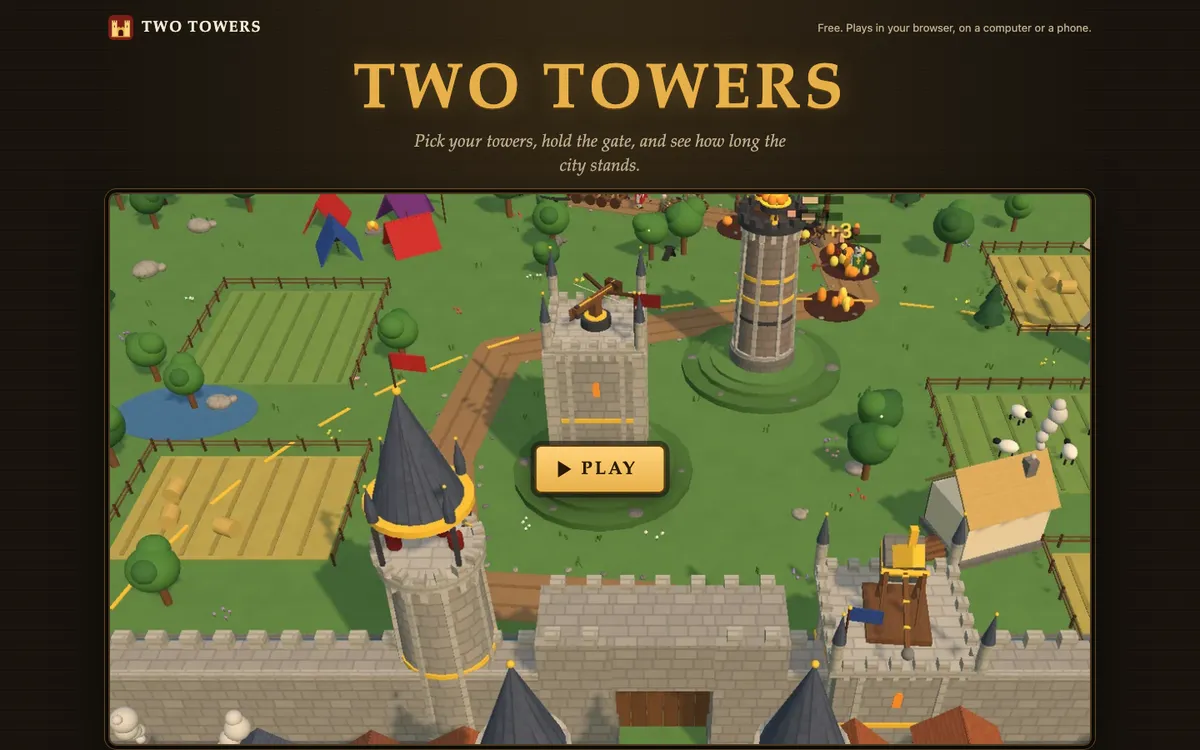
Comments
No comments yet.