Cognitive architecture in AI: what it is and why it matters
A cognitive architecture is a theory of the parts of a mind that stay fixed, built as software you can run. That is the short answer to what cognitive architecture means in AI. The theory says which memories a mind has, how it picks its next step and how it learns. The software lets researchers test the theory on real tasks. This guide explains where the idea came from, how the two best known examples, Soar and ACT-R, work, and why the debate behind them still shapes how people think about building minds.
If you want to feel the pressure on people who build minds for a living, Contain ASI is a collectible card game in your browser where you run a frontier AI lab and race rival labs to superintelligence, and where cutting corners is the fastest way to win and the surest way to lose the future.
What is a cognitive architecture?
Wikipedia's article on cognitive architecture gives it two meanings at once. It is a theory about the structure of the human mind. It is also a computer program that puts that theory into practice, used in AI and in computational cognitive science.
The key word is fixed. One definition quoted in the article calls it a hypothesis about "the fixed structures that provide a mind, whether in natural or artificial systems", and how they work together with knowledge and skills to produce intelligent behavior in many settings. The architecture is the part that does not change from task to task. What changes is the knowledge loaded on top.
So a cognitive architecture is not a program for one job, like a chess engine. It is closer to a blueprint for any intelligent agent. The article notes that cognitive architectures form a subset of general agent architectures, and that the word "architecture" means modelling the structure of a system, not only what it does.
Where the idea came from
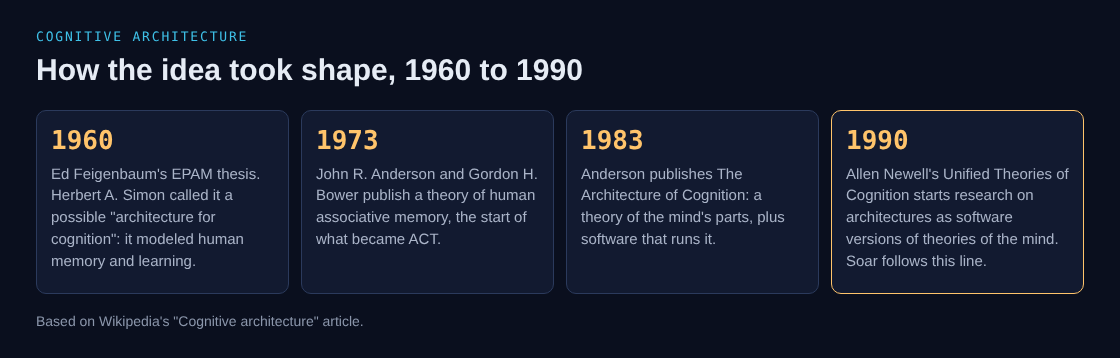
The roots go back to 1960. Herbert A. Simon said his student Ed Feigenbaum's thesis program, EPAM, offered a possible "architecture for cognition", because it made commitments about how human memory and learning work.
John R. Anderson started research on human memory in the early 1970s. His 1973 thesis with Gordon H. Bower set out a theory of human associative memory. He kept adding to it and called the result ACT. In 1983 he published The Architecture of Cognition, which the article calls the seminal work in the area.
The other key figure is Allen Newell. In 1990 his book Unified Theories of Cognition argued that one system should explain many kinds of behavior, and the article credits him with starting research on architectures as software versions of theories of the mind.
Symbolic, connectionist and hybrid designs
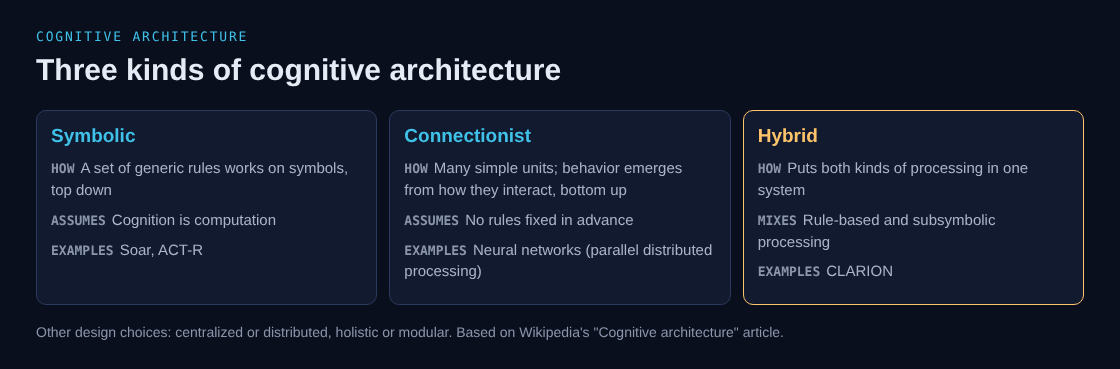
Cognitive architectures come in three broad kinds.
- Symbolic. A set of generic rules works on symbols. Soar and ACT-R are built this way, on the principle that thinking is a kind of computation.
- Connectionist. No rules are fixed in advance. Behavior emerges from many simple processing units working together. The neural network is the prime example, and this approach became popular in the mid-1980s as parallel distributed processing.
- Hybrid. Both kinds of processing in one system. CLARION, developed under Ron Sun, is the example the article gives.
Two more choices cut across these: one central processor or a spread-out design, and one whole or separate modules. For the wider story of the rule-based camp, see our post on symbolic AI, and for attempts to join the two camps, neurosymbolic AI.
Soar: a mind as search through problems
Soar) began in 1983 as John Laird's thesis, and was created by Laird, Allen Newell and Paul Rosenbloom at Carnegie Mellon University. Its goal is the fixed building blocks for general intelligent agents: agents that can plan, solve problems, make decisions and understand language.
Its core idea is the Problem Space Hypothesis. Any goal-directed behavior can be cast as a search through possible states. At each step, Soar selects one operator and applies it to the current state. The name comes from that cycle: State, Operator And Result.
The clever part is what happens when Soar does not know what to do. If its knowledge is incomplete or uncertain, it hits an impasse. The architecture then creates a substate, a smaller problem whose goal is to find the missing knowledge. When the answer comes back and the impasse clears, the substate is removed. Soar's learning is online and step by step: a process called chunking turns the work done in a substate into a new rule, so Soar keeps what it works out.
ACT-R: modelling how people think, step by step
ACT-R, short for Adaptive Control of Thought, Rational, was mainly developed by John Robert Anderson and Christian Lebiere at Carnegie Mellon. Anderson usually credits Newell as the major influence on his theory.
Its central assumption is that human knowledge comes in two kinds that cannot be reduced to each other. Declarative knowledge is facts, such as 2 + 3 = 5. Procedural knowledge is how to do things, such as typing a letter or doing addition. Facts are stored as small units called chunks and reached through buffers, the front ends of modules for vision, hand movements and memory.
Researchers use ACT-R like a programming language. They write a model of a task, such as the Tower of Hanoi or remembering a list of words, and run it. The run gives a step by step simulation of a person doing the task, with predicted response times and accuracy. Those predictions are then checked against real experiments. Soar's recent focus is general AI; ACT-R's has always been modelling human thought in detail.
A worked example: follow one impasse through Soar's cycle
Here is a simplified walk through Soar's ideas, using a small everyday task. It shows the logic of the architecture, not real Soar code. Say an agent's goal is to unlock a door, and it holds a ring of keys.
- State. Working memory holds the goal (door open) and what the agent sees (a locked door, five keys).
- Propose operators. Rules fire in parallel and suggest actions: try key 1, try key 2, and so on.
- Impasse. Nothing says which key is best. The agent cannot select one operator, so the architecture makes a substate.
- Substate. A new, smaller problem: which key is likely to fit? The agent might recall that this door's key is the brass one, or test keys in turn.
- Result. The brass key works. The impasse clears and the substate is removed.
- Learn. Chunking turns what the substate found into a new rule, so next time the right operator is chosen at once, with no impasse.
Try it yourself with a task you do often, like finding a file on your computer. Write down the state, the options, where you would get stuck, and what you would remember next time. You will have sketched your own small cognitive architecture.
Top down or bottom up: the debate behind the designs
The Wikipedia article sets out a deeper split. In traditional AI, intelligence is programmed top down. Even if the system learns, the programmer must supply much of its intelligence. Biologically inspired computing goes bottom up: give the system simple rules or simple units, and let complex behavior emerge from how they interact.
Each side has a case. Rule-based designs like Soar and ACT-R are built to match theories of human thought and can be checked against experiments. Emergent designs rely on learning rather than hand-written rules. The article also notes a middle view: top-down systems based on watching what people and animals do are biologically inspired too, just in a different way. Some designs sit at the edge of the field entirely: Rodney Brooks's subsumption architecture is on the list, though the article says it could be argued whether it is cognitive. For how this work fed into psychology, see how cognitive science and AI grew together.
The question of how a mind is built matters to anyone who worries about powerful AI, because it shapes what can be inspected. Contain ASI's Why this game page puts that worry plainly: "The race is the easy part. Alignment is the hard part." The game is fiction, not a forecast.
Frequently asked questions
What is a cognitive architecture in simple terms?
It is a theory of the fixed parts of a mind, such as its memories and its way of choosing the next step, built as software that can run tasks. Knowledge for each task is added on top.
What are examples of cognitive architectures?
Soar and ACT-R are the best known. Others include CLARION, LIDA, Copycat and Spaun, and Marvin Minsky's Society of Mind is also on Wikipedia's list.
What is the difference between Soar and ACT-R?
Both are rule-based and both trace back to Allen Newell's call for unified theories. Soar's recent focus is general AI, while ACT-R has always focused on modelling human thought in detail, including response times.
Who invented cognitive architecture?
No single person. Herbert A. Simon used the phrase for Ed Feigenbaum's 1960 program EPAM, John R. Anderson built ACT, and Allen Newell started research on architectures as software versions of theories of the mind in 1990.
Get started
Pick one task you do every day and map it the way Soar would: the state, the options, the impasse and what you learn. Then read the Wikipedia articles on Soar and ACT-R linked above to see how researchers turned that kind of map into working systems.
If you want to explore the other side, the race to build ever more capable minds, Contain ASI is a collectible card game in your browser. You sign in with a Google account, and your cards and Credits are the same on your phone and your computer. Its Why this game page says the game's governance levers work as brakes that slow the leader, buy time and can be dodged.
Play Contain ASI: a collectible card game in your browser where you run a frontier AI lab and race rival labs to superintelligence.
January 2024. Four AI labs. One race.
Visit containasi.vlvd.net↗

Comments
No comments yet.