Donnington Castle: a Berkshire castle that held out for King Charles
Donnington Castle, just north of Newbury in Berkshire, was built as a comfortable house with a castle's look. In the English Civil War it became a Royalist stronghold and held out against Parliament's troops for 20 months, from July 1644 to April 1646. Only its gatehouse still stands.
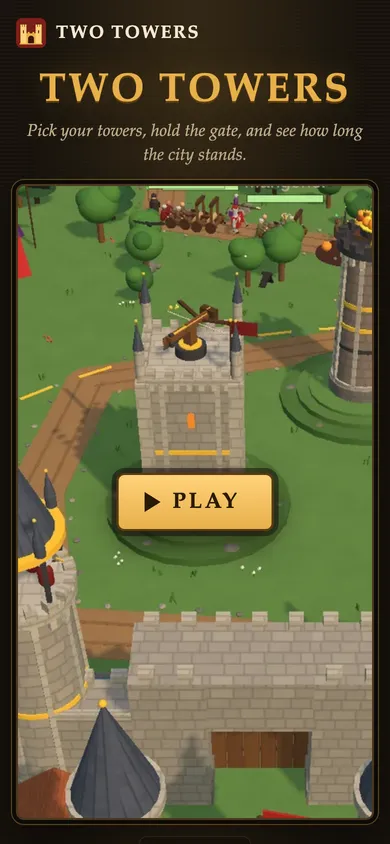
If you like seeing how a defence is built in layers, Two Towers is a free browser game where you pick the two towers that guard a city gate and spend gold on upgrades between stages.
Donnington Castle began as a country house
Sir Richard Abberbury built it in the late 14th century. English Heritage describes him as a soldier, courtier and diplomat who served the Black Prince and Richard II. In 1386 he was granted a licence to crenellate, a permit to fortify his house, and the castle was probably built between then and his death in 1399.
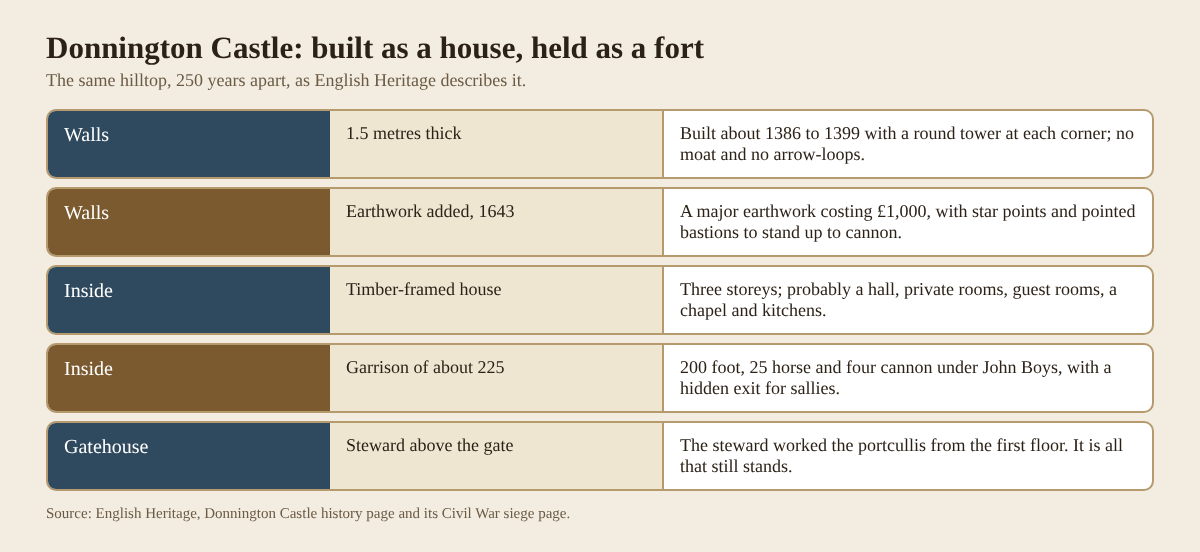
It was a luxury residence more than a fortress. The plan was roughly a rectangle, with a round tower at each corner and a square tower halfway along each long side. The main walls were only 1.5 metres thick, and there was no moat and no arrow-loops. Inside were timber-framed buildings three storeys high. The separate gatehouse was the strongest part: the steward lived on its first floor and could work the portcullis from there. The castle gatehouse post explains why gatehouses were built that way.
Later owners were a mixed line. Thomas Chaucer, son of the poet Geoffrey Chaucer, bought it for 1,000 marks, and his daughter Alice held it for 60 years. Henry VIII gave it to Charles Brandon in 1512. In 1590 Elizabeth I made Lady Elizabeth Russell its keeper, probably the first woman to hold the post. By 1632 it belonged to John Packer, who took Parliament's side.
1643: Colonel Boys and the £1,000 of earthworks
The castle sat on a hilltop overlooking two big roads: the old road from Southampton to Oxford, and the road from London to Bristol and the west. The king's headquarters were in Oxford and Parliament's in London, so whoever held Donnington watched both. After the First Battle of Newbury on 29 September 1643, Charles I sent Lieutenant-Colonel John Boys to take it from Packer and garrison it. He came with 200 foot soldiers, 25 horse and four cannon.
English Heritage calls the castle's defences outdated, so Boys built an earthwork around the whole hilltop. English Heritage says it was a major project that cost £1,000, with pointed bastions, star points that stuck out in different directions to command the ground around, and the biggest, aimed at Newbury, now collapsed. That new outer layer is what saved the castle later.
July 1644: the siege begins
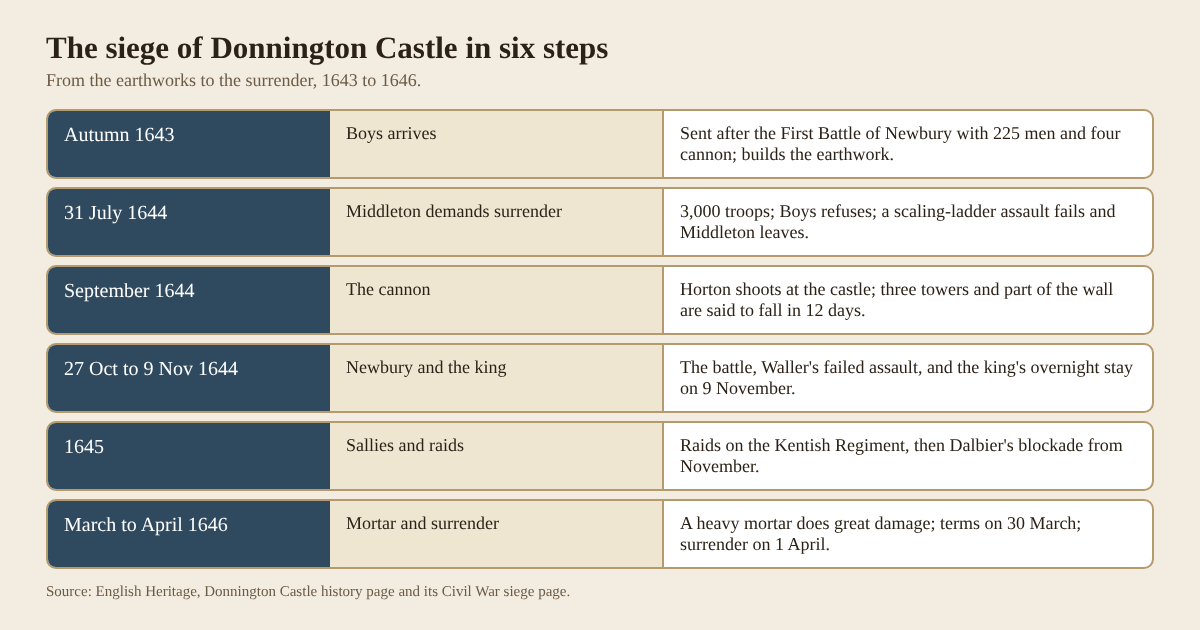
Lieutenant-General John Middleton arrived with 3,000 troops on 31 July 1644. His first demand was polite: surrender, and "honourable terms". Boys answered that he was entrusted by the king's own order, had "not yet learned to obey any other than my Sovereign", and meant to stay. Middleton tried a full assault with scaling ladders. It failed with heavy losses, and he marched west and left the job to local forces.
The siege that followed was rarely a complete blockade. English Heritage says that in quieter times Boys even held a market at the castle to buy provisions. For how a blockade is meant to work, see the starving a castle post.
Cannon, Newbury and a king's overnight stay
In September 1644 Colonel Jeremy Horton set a battery of cannon at the foot of the hill on the Newbury side. It is said that in 12 days of firing he knocked down three of the castle's towers and part of the curtain wall. He then moved his guns to the Snelsmore side. Boys' men made a night attack on the siege works, killed many soldiers and took arms and ammunition. The Earl of Clarendon wrote that over 1,000 shot were fired at the castle in just 19 days. The firing stopped when the king's army reached Newbury in October, and Charles knighted Boys on 22 October for the defence.
On 27 October 1644 the Second Battle of Newbury was fought nearby. The castle's commanding position forced the Parliamentary army to make a long flanking march to the north, and King Charles narrowly avoided capture. The Royalists slipped away overnight, leaving their wounded and artillery at Donnington, plus the king's crown and the Great Seal. Next day Sir William Waller drew up his army before the battered castle and said not one stone would be left upon another. Boys replied that if so, he was not bound to repair it. A Parliamentary assault petered out when its commanding officer was killed. On 9 November the king came back with more troops to relieve the castle, stayed there overnight and recovered his artillery and belongings. The relief army post covers other times when help did, or did not, come.
Sallies, raids and a hidden exit
The garrison did not just sit behind its earthwork. English Heritage says there were many sallies against the besiegers, and the defenders built a hidden exit from the earthwork so they could ambush them. Boys also led longer raids on the Parliamentary Kentish Regiment, six to ten miles away. About 100 foot soldiers went south at night, crossing hedge and ditch to Burghclere, and came back with about 80 horses, weapons and other plunder. When the regiment moved to Woodhay, 120 foot attacked it, carrying axes and hammers to break doors and grenades to throw through windows. Then they went after it at Balsdon House near Inkpen, borrowing cavalry from Wallingford, and caught the regiment sleeping with no guard set.
1646: the mortar and the surrender
In autumn 1645 Colonel John Dalbier was sent to blockade the castle. Boys had burned nearby property so the attackers could not use it for cover or lodging. The winter was stormy and little happened. Then in March 1646 Dalbier brought up a heavy mortar, and it quickly did great damage to the castle and what was left of its defences.
With no hope of relief, the garrison got leave to ask the king at Oxford for permission to give up. His answer was that they should get the best agreement they could. The terms were agreed on 30 March in a field still called Dalbier's Mead, and the castle surrendered on 1 April 1646. The garrison marched away with colours flying, drums beating and as much ammunition as each man could carry. Parliament then ordered the castle pulled down, and only the gatehouse was left standing. See also the slighting a castle post. The ruin became a landmark for 18th and 19th century visitors, was scheduled as an Ancient Monument in 1925 and was given to the Crown in 1952.
A worked example: Boys' layers as a Two Towers plan
Donnington lasted because Boys added a layer outside the old walls and the garrison kept fighting, and it fell when a weapon outranged what was left. You can try the same thinking in Two Towers with a plan that uses only what the game says.
- Add your outer layer early. Buy the first hill tower, which costs 150 gold and can be any of the four kinds.
- Give the hill tower Range. The game's tip says: "Mangonels throw stones from far off: a hill tower with Range reaches them." Reach is how you answer what outranges the gate.
- Slow them down. The title screen says "Raise barricades to slow them down." and the game text gives no price, so check the cost in the game.
- Harden the gate for rams. The tip says: "Rams hit the gate hardest: Reinforce the gate, and use Ballista bolts that ignore armor."
- Prepare for the king. He leads every fifth stage, and the tip says: "Reinforce the gate before it and save gold for Damage." The second hill tower costs 300 gold, so decide whether it comes before or after.
If the gate falls anyway, the game tells you which attacker did most of the damage, with a line that begins "The gate fell mostly to". Plan the next game around that attacker. The hill towers post has more on where to build.
Frequently asked questions
How long was the siege of Donnington Castle?
About 20 months. English Heritage says it began in July 1644 and ended when the garrison surrendered on 1 April 1646, though it was rarely a total blockade.
Who defended Donnington Castle?
Colonel John Boys, who was knighted by Charles I in 1644. He arrived in 1643 with about 225 men and four cannon and built the earthworks that protected the castle.
What is left of Donnington Castle?
The gatehouse, built in the late 14th century with two towers, and the earthworks of the Civil War. English Heritage says most of the rest was pulled down after the surrender in 1646.
Why was Donnington Castle important in the Civil War?
It sat on a hilltop above the roads from Southampton to Oxford and from London to the west. With Oxford the king's base and London Parliament's, holding it meant watching both roads.
Get started
Donnington lasted by building outward and then ran out of answers to a mortar. To test your own layers, play Two Towers: pick your towers, add reach on the hills and see how long your gate holds.
Defend the castle gate, stage after stage.
Visit twotowers.vlvd.net↗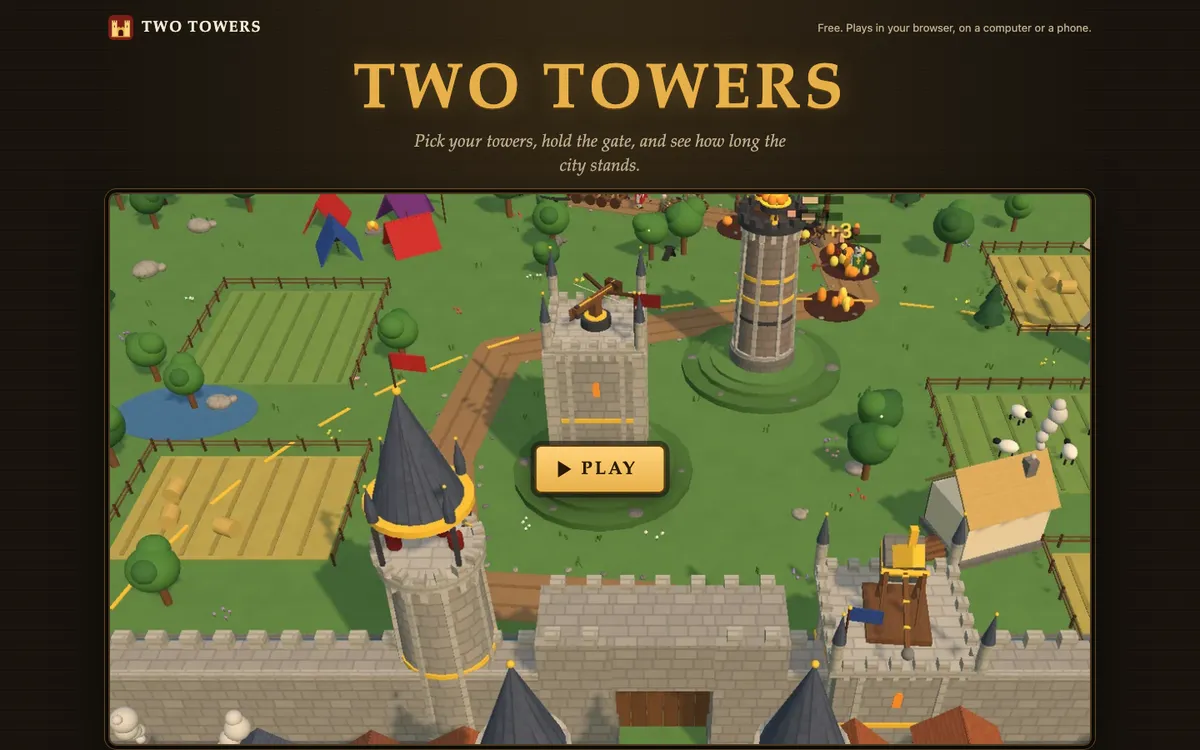
Comments
No comments yet.
Sign in or make an account to comment.