Farleigh Hungerford Castle history: a fortified mansion
Farleigh Hungerford Castle, on the Somerset border with Wiltshire, looks like a fortress and was built to be a home. This Farleigh Hungerford Castle history follows it from a fortified mansion begun before 1383 to a family whose fortunes rose and crashed for 300 years, then to a plundered ruin that was rescued in the 20th century. It also gives you a three-question way to read any castle's walls.
If you like weighing comfort against defence, Two Towers is a free browser tower defense game where you choose which two towers guard a city gate and spend gold to hold it against stronger attackers every stage.
Farleigh Hungerford Castle history: begun before 1383
The castle was begun before 1383 by Sir Thomas Hungerford, who came from a family of modest influence in Wiltshire and prospered as chief land steward to John of Gaunt. English Heritage says he was elected Speaker of the Commons in January 1377, the first formally recorded holder of that office. His castle was, in English Heritage's words, essentially a symbol of his rising status.
What he built was a fortified mansion: four ranges of rooms around a rectangular courtyard, with a tall tower at each corner. It stood on an earlier manor house that he bought in 1369. The place had no strategic importance and no strong natural defences, but it was remote from rival landowners, which suited the seat of a hoped-for dynasty. Sir Thomas chose to be buried here, and his monument is in the chapel he built as the parish church.
On 26 November 1383 he bought a royal pardon for having already fortified his mansion. The licence to crenellate post reads that pardon next to five other castles.
A castle that faced two ways
English Heritage puts Farleigh in a small group of castles built in the last three decades of the 14th century, mainly by men close to the court of Richard II, which were in reality fortified mansions rather than fortresses. Bodiam and Bolton are quadrangular in the same way. The plan allowed the inner faces of each range to be lit by large windows looking onto the courtyard, while the outer faces stayed sheer and almost windowless. English Heritage calls this a compromise between luxury and security.
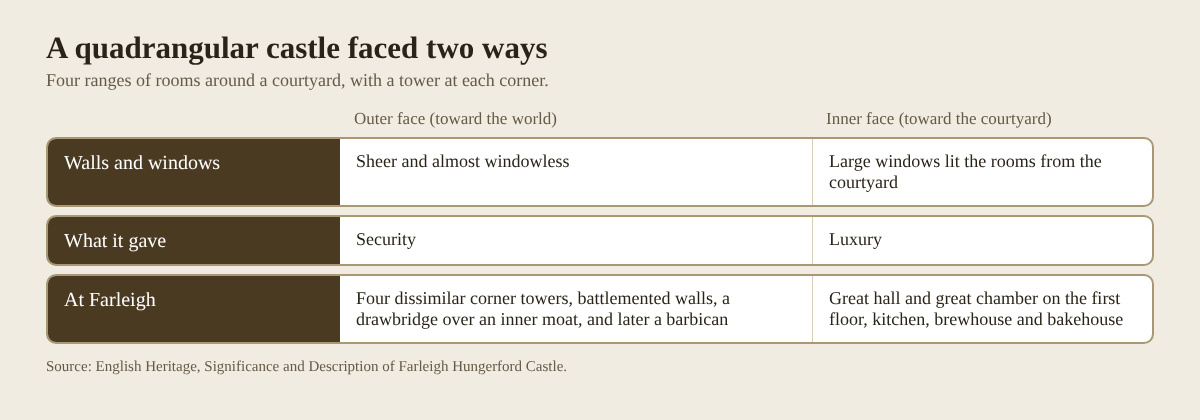
At Farleigh a high round tower stood at each corner, first with a conical roof. The four towers are not alike. The south-west one, the Lady Tower, had five floors of circular rooms. English Heritage says it got its name from a tradition, probably mistaken, that Sir Walter Hungerford III's wife Elizabeth was held there in the 1530s. Battlemented walls linked the towers, and the rooms ran around the courtyard behind them. The hall range held the great hall and great chamber on the first floor, over undercrofts, with the kitchen, well, brewhouse and bakehouse at the west end. For what happened in a hall like this, see the castle great hall post.
Walter's outer court and the barbican
The man who made Farleigh a big castle was Sir Thomas's son Walter, 1st Lord Hungerford (1378 to 1449). He fought with Henry V at Agincourt in 1415, became a Knight of the Garter and served as Treasurer of England from 1426 to 1432. By tradition, English Heritage says, his building work was paid for mainly by the ransoms of French prisoners.
Probably between about 1430 and 1445 he improved the inner court and added a barbican outside its gates. The inner court was approached by a drawbridge over an inner moat, and the barbican, now seen as arrowhead-shaped foundations, reinforced that entrance. He also built the outer court, with a curtain wall, towers and gatehouses, which almost doubled the size of the castle. It enclosed the old parish church, which he made the castle chapel, and he built a house for the priests who prayed there. For why a barbican was added to a gate, see the barbican post.
The outer court's high curtain wall runs to a big semicircular south tower with arrowslits for covering the deep dry ditch and its approaches. English Heritage calls it a noteworthy survival from a time when few defences were built in southern England, and notes that Walter had first-hand experience of besieging French fortresses. Under the north chapel of St Leonard, in the same court, lie eight human-shaped lead coffins, the finest collection of that kind in Britain. The castle chapels post has more on chapels like it.
Disasters, scandals and one small war
The Hungerfords' luck did not follow their castle's strength. Robert, the 3rd and last Lord Hungerford, and his eldest son were executed for backing the Lancastrian side in the Wars of the Roses, and the Yorkist regime took the castle in 1462. Sir Walter Hungerford II won it back in 1486 as a reward for supporting Henry VII at Bosworth the year before.
English Heritage then lists a murder, an imprisonment and an execution. After Sir Edward Hungerford died in 1522, his widow Agnes was hanged for murdering her first husband and burning his body in the castle's kitchen furnace. Sir Walter Hungerford III held his third wife, Elizabeth, in the castle for nearly four years. He was executed alongside Thomas Cromwell on 28 July 1540, and the Crown took the castle again. It was bought back in 1554 by Sir Walter Hungerford IV.
The fighting, by comparison, was small. In the first Civil War, Sir Edward Hungerford III commanded Parliament's forces in Wiltshire and, English Heritage says, proved rather incompetent, abandoning Salisbury, Malmesbury and Devizes to the Royalists. His Royalist half-brother John seized and garrisoned the castle. A few skirmishes followed, which English Heritage calls the only known military actions in its history, and it was regained in 1645 for Sir Edward, who died there in 1648. For castles that saw real sieges, read the Civil War castle sieges post.
From plunder to preservation
The last Hungerford of Farleigh, Sir Edward IV, was known as "the Spendthrift" for his extravagance, and sold the castle in 1686 when he could not repay his debts. In 1705 the Houlton family bought it for salvage, and over the next decades the castle was plundered for its materials and fittings. Only the priests' house stayed lived in. By the 1830s the castle had become what English Heritage calls a "repository of curiosities".
The ruins, covered in ivy, were a favourite subject for artists, and when the Ministry of Works took guardianship in 1915 and began stripping foliage and repointing stonework, Country Life magazine condemned it as "the icy touch of a mechanistic and bureaucratic age". English Heritage says that controversy was an important episode in the history of heritage conservation in England. It has cared for the castle since 1984.
A worked example: read a castle's walls in three questions
Farleigh is a good place to practise, because its walls do two jobs. Use three questions, and take the answers only from what the sources say.
- What faces outward? Sheer, almost windowless walls and corner towers. That is the security half of the compromise.
- What faces inward? Large windows onto the courtyard and a hall range with a great hall and great chamber. That is the luxury half.
- What was added at the entrance, and when? A drawbridge over an inner moat, then, probably between about 1430 and 1445, a barbican outside the inner gates, and an outer court whose south tower had arrowslits over the dry ditch.
The answers show an owner who paid for comfort first and strengthened the front door later. Compare the licence to crenellate post, where the same question runs over six castles.
The same trade-off in Two Towers
Every stage in Two Towers asks for the same compromise in gold. You pick your two towers on the title screen from Archer Tower, Trebuchet, Ballista and Fire Tower, and you spend what you win on upgrades or on strengthening the gate. The game's own general tip says: "Spend your gold on Damage between stages, and Reinforce the gate." Walter's barbican was a reinforcement of exactly that kind, put outside a gate that already had a drawbridge.
Put the questions to your own defence. What faces the road? Your towers and their range. What protects the gate when something gets through? The tips are direct: "Rams hit the gate hardest: Reinforce the gate, and use Ballista bolts that ignore armor." Gold in the game is in-game gold, never money. A plan in the spirit of Farleigh: before each stage, check which tip the next attackers match, then decide whether the gold goes to the towers or the gate, and do not leave the gate for last.
The game is free, with no ads, and plays in your browser on a computer or a phone. Signing in is optional.
Frequently asked questions
Who built Farleigh Hungerford Castle?
Sir Thomas Hungerford began it before 1383. His son Walter, 1st Lord Hungerford, enlarged it between about 1430 and 1445 with an outer court, a barbican and a south tower.
Was Farleigh Hungerford a real castle?
English Heritage places it among castles that were in reality fortified mansions rather than fortresses. It had towers, a drawbridge, a moat and a barbican, but the only fighting recorded there was a few Civil War skirmishes.
Where is Farleigh Hungerford Castle?
It stands on the Somerset border with Wiltshire, on rising ground above the Devil's Dyke brook, a tributary of the river Frome.
Why is one tower called the Lady Tower?
The south-west tower is named for a tradition that Elizabeth, wife of Sir Walter Hungerford III, was held there in the 1530s. English Heritage says the tradition is probably mistaken.
Get started
Farleigh Hungerford shows a builder who weighed comfort against defence and kept adjusting the balance. Try the same choice in Two Towers, free in your browser. Pick your two towers, read the tip for each attacker, and decide where the next gold goes.
Defend the castle gate, stage after stage.
Visit twotowers.vlvd.net↗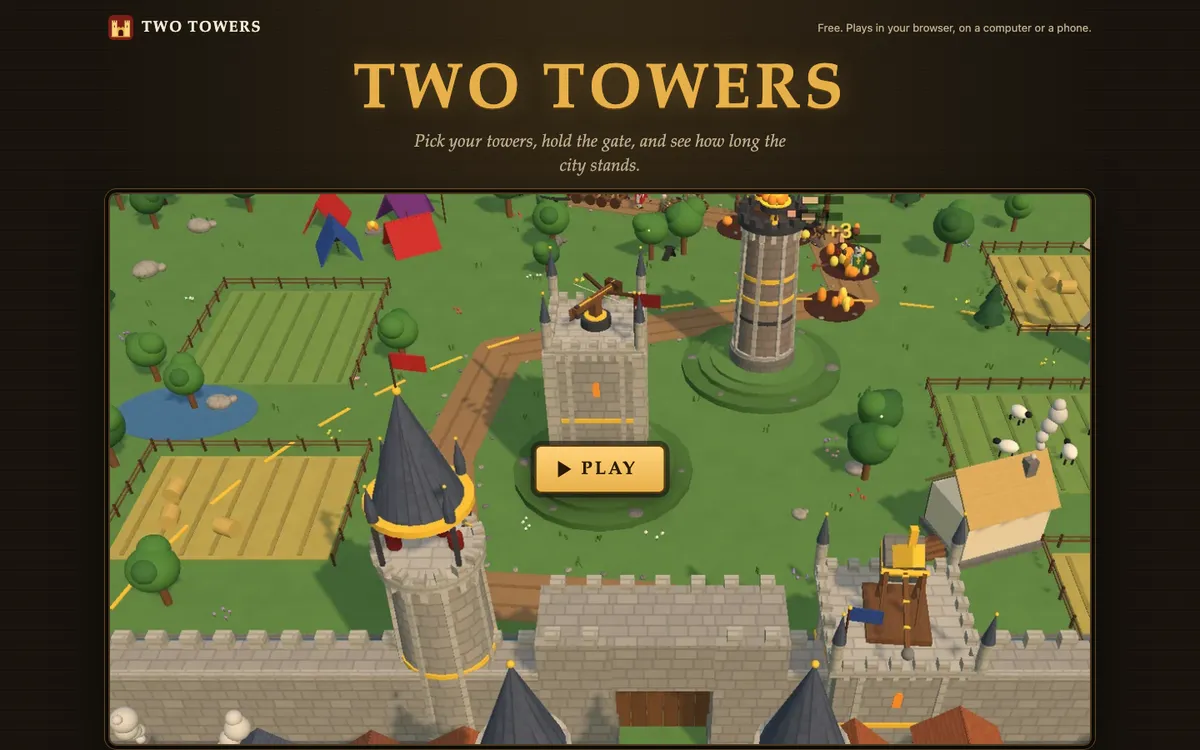
Comments
No comments yet.
Sign in or make an account to comment.