Longtown Castle: a Roman fort reused on the Welsh border
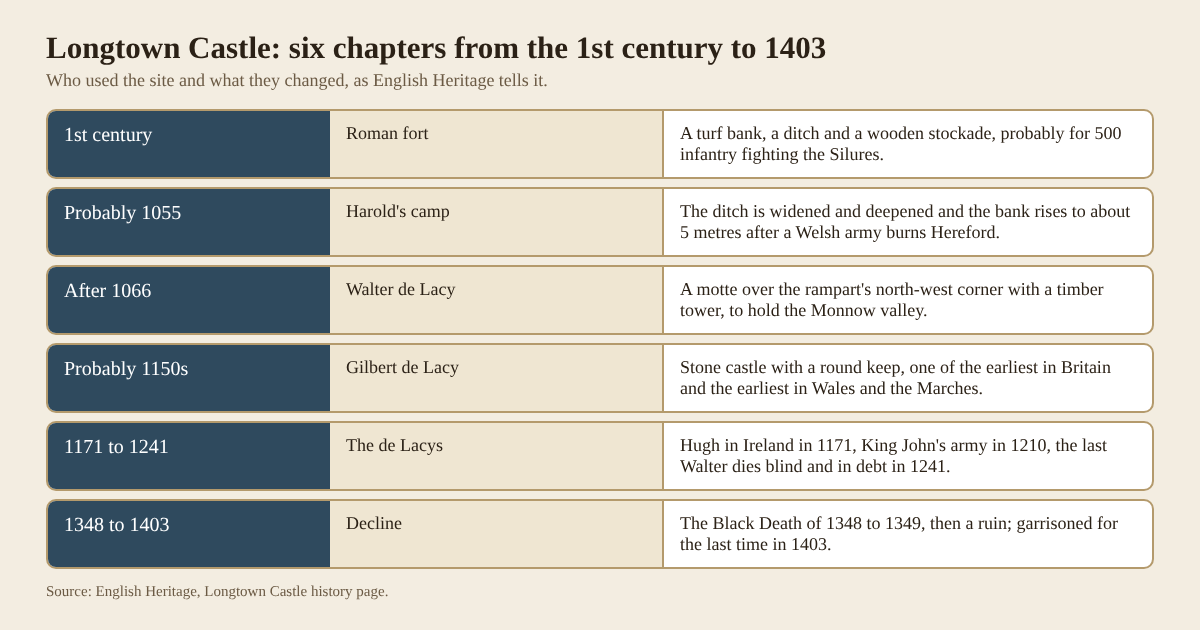
Longtown Castle in Herefordshire looks like a Norman border castle with a round keep, but English Heritage says its story starts nearly 2,000 years earlier, with a Roman fort. The ramparts around the castle and the village green are the Romans' own, raised higher in the 11th century, and the round keep on top of the motte was probably built in the 1150s.
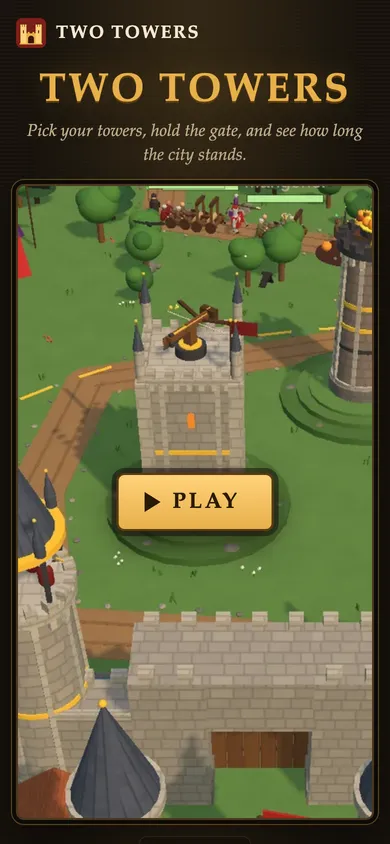
If you like seeing how layers of defence hold a border, Two Towers is a free browser game where you choose the two towers that guard a city gate and spend your gold on upgrades between stages.
Longtown Castle began as a Roman fort
English Heritage says recent documentary research and excavations show that Longtown has Roman origins. It was probably a fort for a cohort of 500 infantry, sent to fight the Silures, a British tribe resisting Roman rule. It was one of a group of forts built in the 1st century, each a day's march from the next, along the front line with the upland tribes who were fighting to keep their independence. The first fort was simple: a square embankment of turf, a ditch around it and a wooden stockade on top.
The same idea of a fort that grows into a castle runs through the Pevensey Castle post, where the Normans moved into a Roman fort on the south coast. Longtown did it on the Welsh border.
1055: Harold's army camps in the old fort
About a thousand years later, someone widened and deepened the ditch. The spoil went onto the Romans' low turf bank and lifted it to around 5 metres. English Heritage says this probably happened in 1055, after a Welsh army had looted and burnt Hereford. An Anglo-Saxon army under Earl Harold Godwinson, later King Harold, chased the raiders back into Wales and made its camp at Longtown, waiting for an attack that never came. So the great rampart that surrounds both the castle and the village green was strengthened before the Normans ever arrived.
Walter de Lacy and the first castle on the mound
In 1066 Harold was killed at Hastings. William the Conqueror sent William FitzOsbern and Walter de Lacy to Herefordshire to guard the Welsh border, and they built a chain of castles from Chepstow to Ludlow. Walter's first was at Walterstone, 4 miles south of Longtown. English Heritage thinks the old fort at Longtown was probably held by a Welsh force hostile to the Normans, and that Walter began another castle at Ponthendre, just south of it, to counter the threat. When the fighting came he abandoned Ponthendre unfinished and took over the Longtown fort.
Walter raised an earth mound over the north-west corner of the rampart and set a timber tower on it. From there he dominated the local Welsh people in the Monnow valley and also defended them from raids out of the parts of Wales that were still independent. For how this first kind of Norman castle worked, see the motte and bailey post.
The round keep of the 1150s
The de Lacys lost and regained Longtown. After William the Conqueror died in 1087, Walter's son Roger twice conspired unsuccessfully against the new king, William Rufus, and was exiled to Normandy, and his castles at Walterstone, Longtown, Weobley and Ludlow were confiscated. During the Anarchy of King Stephen's reign, from 1135 to 1153, Roger's son Gilbert fought to win back his father's property, and around 1148 he recovered it.
The Longtown Castles Project, which English Heritage cites, suggests that Gilbert probably replaced the wooden castle with the stone one. A stone keep stands on the motte in the shape of a cylinder, and English Heritage calls it one of the earliest round keeps in Britain and the earliest in Wales and the Welsh Marches. The stone castle was long thought to date from the early 13th century, and the new research moves it to the 1150s. For other round towers, see the Conisbrough Castle post.
Walking through the castle
Little survives of the stone walls of the inner and outer baileys, but what remains shows walls 2 metres thick with a wall-walk about 3 metres high, probably under a crenellated parapet. The original main gateway, now ruined and blocked, opened into the outer bailey, which probably held barracks for soldiers and stables for their horses. The small gatehouse to the inner bailey still has its slot for a portcullis. Its entrance is just large enough for a mounted man, which English Heritage reads as a sign that the inner bailey was kept for important people such as the knights and their families. For the gate parts, see the castle gatehouse post.
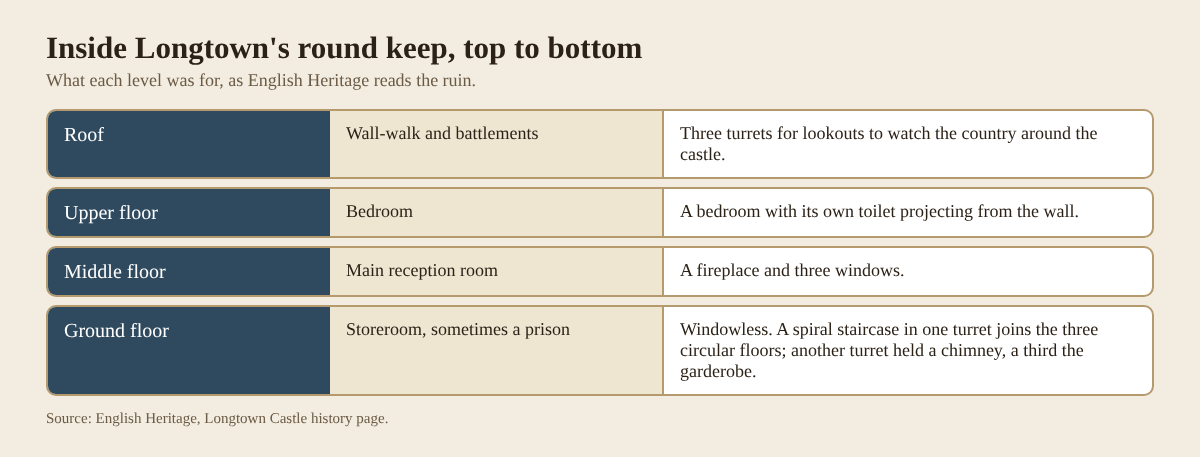
The keep held the lord's own rooms. A wall-walk with battlements and three turrets let lookouts watch the country, and if the outer defences fell, it was the garrison's last refuge. A spiral staircase in one of the three turrets linked three circular floors, and one surviving turret had a chimney while another held a garderobe. The windowless ground floor was probably a storeroom and sometimes a prison. Above it came the main reception room, with a fireplace and three windows, and the top floor was a bedroom with its own toilet projecting from the wall. The garderobe post explains how that kind of toilet worked.
The Long Town and the end of the de Lacys
The castle needed paying for, so the de Lacys laid out a new town along the ridge to its north and south. It was soon called the Long Town of Ewias Lacy, which gave the place its name. The family grew very rich, and richer still when Gilbert's son Hugh sailed with Henry II's army to Ireland in 1171 and for a time became viceroy there. By 1210 they had overreached themselves, and King John sent an army to expel them.
The last de Lacy, another Walter, fell on hard times. He died in 1241, blind and deep in debt, and because his only son was already dead, the estates were split between his two granddaughters. Longtown lost its role as a regional centre, and the Black Death of 1348 to 1349 shrank it further, as it did so many towns and villages. Soon afterwards the castle became a ruin. It was garrisoned for the last time in 1403, on the orders of Henry IV, when Owain Glyn Dwr led the Welsh in rebellion.
A worked example: Longtown's layers as a Two Towers plan
Longtown shows a gate defended in layers: a rampart, an outer bailey, a narrow inner gatehouse and a keep to fall back on. You can lay out a plan with the same four layers in Two Towers, using only what the game says.
- The rampart: pick two towers. Choose from Archer Tower, Trebuchet, Ballista and Fire Tower for the left and right of the gate. A Ballista and a Fire Tower both answer armor: the game's tip says "Knights' armor turns arrows: Ballista bolts and fire go straight through it."
- The outer bailey: the first hill tower. Buy a tower for one hill. It costs 150 gold, and it can be any of the four kinds.
- The inner gatehouse: the gate itself. Between attacks you can repair or reinforce the gate. For the hardest hitters, the tip says: "Rams hit the gate hardest: Reinforce the gate, and use Ballista bolts that ignore armor."
- The keep: gold in reserve. The second hill tower costs 300 gold. Keep gold back before the king, who leads every fifth stage: "Reinforce the gate before it and save gold for Damage."
Then play a few stages and see which layer the attackers reach first. If it is the gate, shift your next gold there.
Frequently asked questions
Was Longtown Castle built on a Roman fort?
Yes. English Heritage says recent research and excavations show Longtown has Roman origins, with a 1st-century fort probably used by a cohort of about 500 infantry. The castle sits within that fort's rampart.
When was Longtown Castle's round keep built?
Probably in the 1150s. The stone castle was long thought to be of the early 13th century, and research by the Longtown Castles Project suggests Gilbert de Lacy built it after recovering his inheritance around 1148.
Who built Longtown Castle?
Walter de Lacy raised the first castle, a motte with a timber tower, after 1066. English Heritage says his descendant Gilbert probably rebuilt it in stone.
When was Longtown Castle last used?
It was garrisoned for the last time in 1403, on the orders of Henry IV, when Owain Glyn Dwr led the Welsh in rebellion. It soon became a ruin.
Get started
Longtown shows how a gate, a gatehouse and a keep can share the work. To test your own layers, play Two Towers: pick your two towers, buy the hills when you can and see how long your gate holds.
Defend the castle gate, stage after stage.
Visit twotowers.vlvd.net↗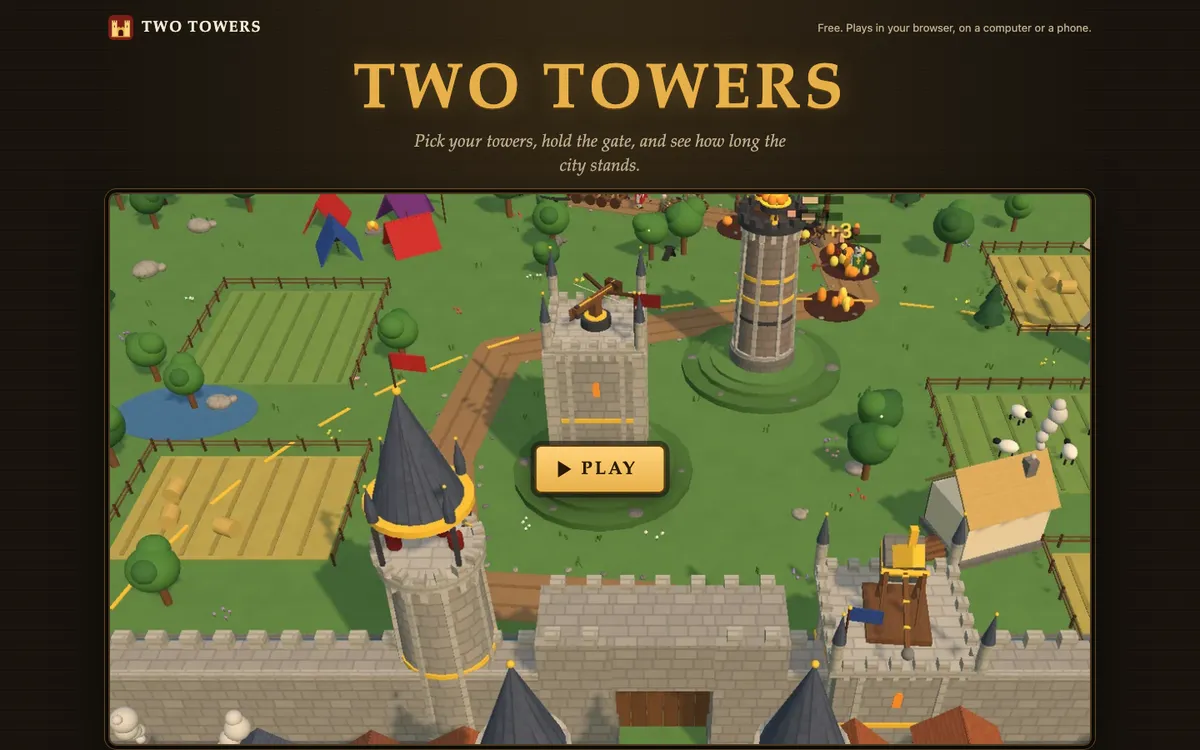
Comments
No comments yet.
Sign in or make an account to comment.