Totnes Castle: a Norman castle that never saw a siege
Totnes Castle, in Devon, is a Norman motte-and-bailey that never saw a siege. English Heritage says it was founded around 1087 and that its history was "one of gradual decline through the Middle Ages", with effective abandonment in the 16th century. This post follows what a castle that was never attacked was for, why a stone keep went up on its mound, and how it came to be a ruin on a hill above a busy town.
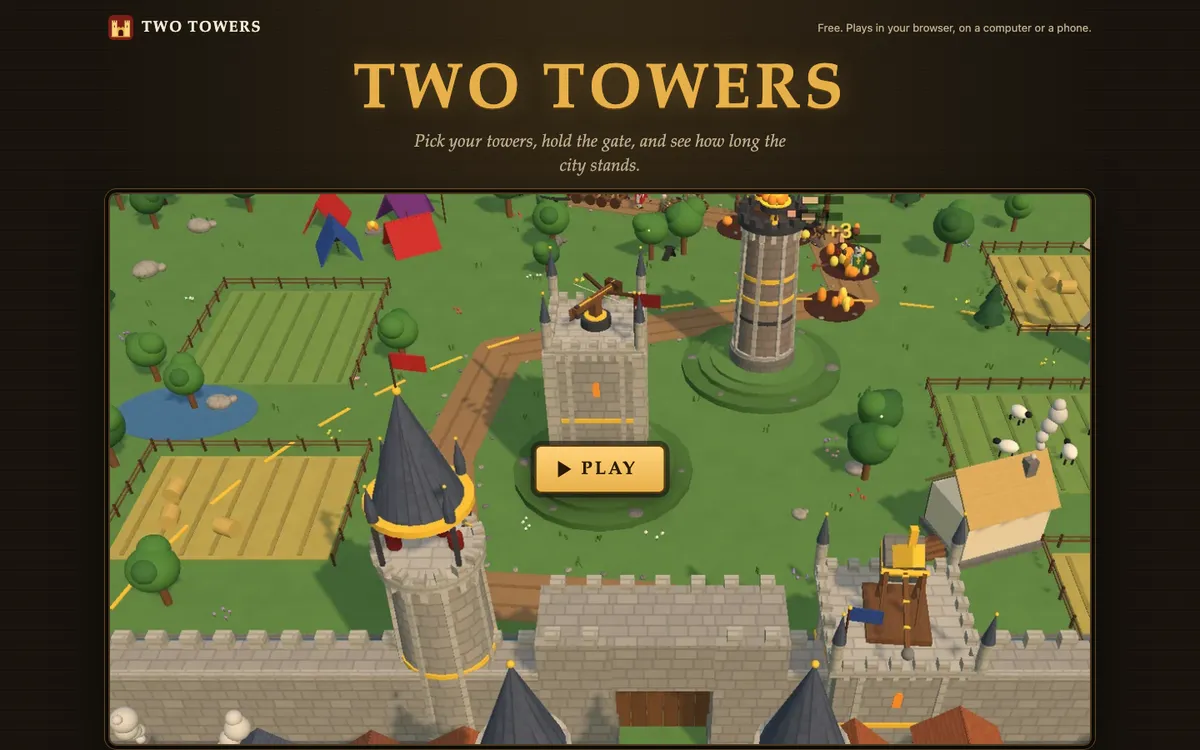
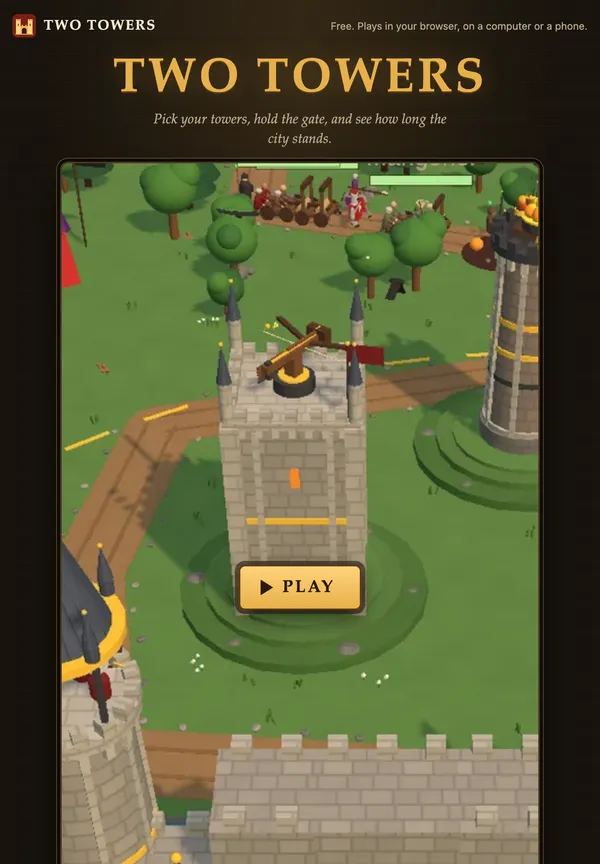
If you like working out what a defence is really for, Two Towers is a free browser tower defense game where you choose which two towers guard a city gate and spend gold to hold it against stronger attackers every stage.
Totnes Castle: a castle set on top of a town
Totnes was a town long before the castle. It stands at the lowest point where the river Dart can be bridged and the highest point that sea-going ships could reach. From the 10th century it is better known: it was one of four burhs in Devon, fortified settlements that gave protection from Viking raiders, and by the middle of the 10th century it had a mint.
English Heritage reads the town's street plan as proof that the castle came second. The narrow plots along the High Street and the curving boundaries to north and south are late Anglo-Saxon planning. The castle sits at the town's highest point and disrupts that plan, so it was imposed on a town that already existed.
Judhael and the first castle
The castle followed directly from the Norman Conquest of 1066. William the Conqueror gave one of his supporters, Judhael of Brittany, a large estate in Devon with Totnes as its chief town. Judhael established the castle, and he also founded a Benedictine priory on the spot where St Mary's Church now stands.
The castle took the form we call a motte-and-bailey, probably from the start. English Heritage describes a high conical mound, the motte, which is thought to be a natural outcrop that was heightened by hand, and a larger enclosure on level ground below it, the bailey. The bailey held the principal buildings: the hall, chambers, chapel and kitchens. The deep ditches on the north side of the bailey were probably dug as part of the first works.
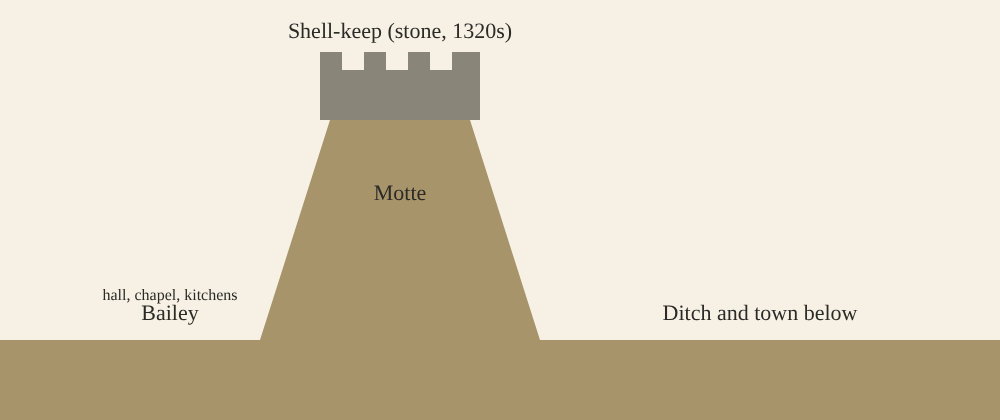
The shape of a motte-and-bailey like Totnes, simplified.
The first defences, on the bailey and on top of the motte, were timber. The stone walls and the shell-keep that visitors see now were later replacements. Excavation in the 20th century, together with comparison with other castles, suggests that the motte was first crowned by a tall timber watchtower inside a palisade, a high fence of upright beams.
That matters for how you picture Totnes. The castle you can walk round today is not the one Judhael built. The shape of the hill and the ditches go back to the 11th century, but the stonework is from the Middle Ages that followed.
What a castle with no siege did all day
English Heritage is blunt: the story of Totnes is "not one of sieges or captures", and throughout the Middle Ages the castle did peaceable jobs in the government of its district. Presumably it was where rents were paid to the lord and where offenders were tried and imprisoned (the same job described in the post on castle prisons).
Documents about the lordship of Totnes mention the castle often. Tenants had to supply bread, wine and ale for the lord's use, provide men to guard the castle, and pay for the repair of a set number of battlements on the castle wall. The castle was a reason to collect services as much as a place to fight.
The lords changed several times, either because a lord fell out of royal favour or, more often, because the family had no heir. The Nonant family held it through the 12th century, the Briouze and Cantilupe families through the 13th, and the Zouches, a Northamptonshire family, until 1485.
The shell-keep of the 1320s
Owners with other, more comfortable homes did not spend money here. A survey in 1273 found the hall, chamber and chapel in the bailey weak or ruinous, the bailey's stone walls in the same state, and the stone defences on the motte near collapse.
In the 1320s William, 1st lord Zouche, replaced the derelict structure on the motte with the shell-keep we see today. A shell-keep is a circular or oval wall on the top of a motte, enclosing a courtyard and buildings. In 1326 Lord William had backed the nobles who deposed Edward II. English Heritage suggests that the political instability at the end of that reign may have encouraged him to strengthen Totnes. The wall is capped with battlements and a wall-walk, which let defenders shoot in all directions; the battlements post explains how that worked. Evidence of a building against the wall can still be seen on the north-west side.
So the one big piece of stone defence at Totnes was built in an anxious year, and as far as English Heritage records, no enemy ever tested it.
A declining castle in a thriving town
By the late 15th century the motte was overgrown with trees and shrubs. After Henry VII took the throne in 1485, Totnes was awarded to the Edgecumbes, who had supported him against Richard III, and again nothing was done to repair it. By 1538 the castle contained no intact buildings.
Even so, tenants in the region still held property in exchange for services to it. English Heritage describes the castle's survival as almost a legal fiction, because it underpinned the whole system of land tenure. In the mid 16th century it was sold to a Totnes merchant family, and in 1591 to the Seymours, owners of nearby Berry Pomeroy, who were turning that castle into a comfortable residence.
The town did the opposite. In this period Totnes reached its zenith, as merchants exported cloth and tin to France and Spain and spent their profits on rebuilding houses and civic buildings; many buildings on Fore Street and the High Street date from then. The prosperity was short, and by the end of the 17th century exports had shrunk a lot.
After the 18th century the castle was only an ancient monument and a place of recreation. Trees were planted, and a gently sloping path replaced the steep medieval stairway to the top of the motte. It opened to the public as a pleasure-ground in the 1920s, with cream teas and a tennis court in the bailey.
By 1947 parts of the stonework threatened to collapse, and the Duke of Somerset put the ruins into the guardianship of the Ministry of Works. The motte was restored to its medieval look, without trees, and excavations on top found the base of a watchtower, probably built in the 11th century when the castle was new. English Heritage has cared for Totnes Castle since 1984.
A worked example: judge a defence by its enemy
Totnes gives you a useful habit: ask who the defence was built against before you judge it. Try it in three steps, using only what English Heritage says.
- Name the threat. In the 1080s, the Normans needed to hold a conquered town. In the 1320s, the threat was political instability after a king was deposed.
- Match the wall to it. A timber tower on a mound could be raised fast. A stone shell-keep with a wall-walk could be shot from in all directions, which suits a threat that might come from anywhere.
- Check what happened. No siege came. The defence did its work by being seen, and the castle's real value was collecting rents, holding courts and anchoring land tenure.
You can try the same test on a battle you do fight. The castle keep post shows a keep built for the real thing, and the Bowes Castle post shows one that did meet an army.
The same question in Two Towers
In Two Towers you cannot build for a threat that never arrives: every stage comes stronger, faster or in greater numbers than the last, and the gate falls if you guess wrong. On the title screen you pick the tower for each side of the gate: Archer Tower, Trebuchet, Ballista or Fire Tower. The game's own tips tell you who is coming. One reads: "Archers shoot the gate from the road: buy Range so your towers reach them before they stop."
Here is a short plan in the Totnes spirit. First, read each tip and name the threat it describes. Second, click or tap a tower and buy the upgrade that answers that threat, such as range for archers. Third, keep gold in hand for a hill tower, 150 gold for the first and 300 for the second. Gold in the game is in-game gold, never money.
The game is free, with no ads, and plays in your browser on a computer or a phone. Signing in is optional.
Frequently asked questions
Was Totnes Castle ever besieged?
English Heritage says it saw no sieges or battles. Its Middle Ages were peaceable, with the castle used for the government of its district.
When was Totnes Castle built?
It was founded around 1087 by Judhael of Brittany, who held the estate from William the Conqueror. The stone shell-keep on the mound was built in the 1320s by William, 1st lord Zouche.
What is a shell-keep?
It is a circular or oval wall on the top of a motte, enclosing a courtyard and buildings. At Totnes the wall has battlements and a wall-walk for defenders.
Who owns Totnes Castle now?
English Heritage has cared for it since 1984. Check its page for opening times before you visit.
Get started
Totnes Castle teaches one habit: match the defence to the enemy you expect, then watch for the one you did not. Try that in Two Towers, free in your browser. Pick your two towers, read the tip for each attacker, and spend your gold where the next stage will hit.
Comments
No comments yet.
Sign in or make an account to comment.