What is a domestic longhair cat? Long coat, mixed ancestry, care
What is a domestic longhair cat? It is a long-coated cat of mixed ancestry, not a breed. PDSA, the UK vet charity, says domestic shorthairs, longhairs and medium hairs are not a recognised breed, yet they are still the most common type of cat owned in the UK. A domestic longhair simply has a much longer coat, which needs regular grooming. This guide covers how to tell one apart from a longhaired pedigree, what to expect, and a short daily groom.
If you meet fluffy cats on your walks, Cat Go lets you photograph each one, pick its breed from a list, and keep it in a collection with the place you met it.
What is a domestic longhair cat, in plain terms
"Domestic longhair" describes a coat, not a family tree. PDSA's domestic breeds page groups everyday cats by coat length:
- Domestic shorthair: a short, sleek coat.
- Domestic medium hair: a slightly longer, sleek coat.
- Domestic longhair: a much longer coat that needs regular grooming.
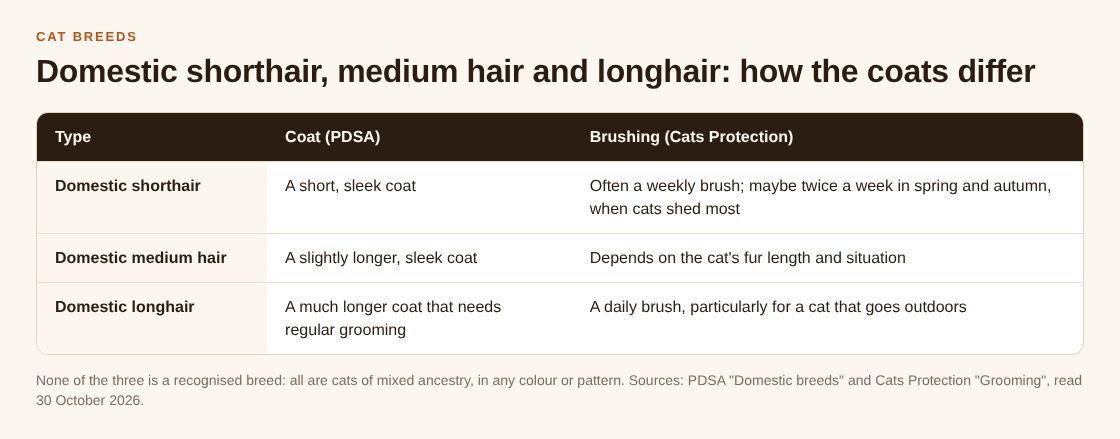
All three come in many colours and patterns. PDSA lists tortoiseshell, calico, tabby, and solid colours from black through to white. If your cat's coat is short, the companion guide is what a domestic shorthair cat is.
Why a domestic longhair is not a breed
Each recognized breed has a written standard that cats are judged against. A domestic longhair has none. PDSA says domestic cats are of mixed ancestry, so their looks and temperament vary greatly from one cat to the next. They can have very different body types, shapes and builds, depending on the breeds in their genetic history.
That is also why PDSA lists no specific health issues for domestic cats: their genetic base is very wide. It gives an average lifespan of 12 to 15 years and an average weight of 4 kg, as a general guide rather than a rule for your cat.
Domestic longhair or longhaired pedigree?
Long fur alone does not make a cat a Persian, a Maine Coon or a Norwegian Forest Cat. Each of those breeds has its own standard for head shape, body, eyes and coat, which our breed guides set out from the Cat Fanciers' Association's pages:
For a long-coated cat whose background you do not know, the safe answer is "domestic longhair", in other words mixed breed. Our guide is my cat a mixed breed? walks through the checks.
Mixed breed cats can still be shown. The CFA's Household Pet class judges them on uniqueness, pleasing appearance, unusual markings and sweet dispositions, rather than against a breed standard. Its rules say a household pet may not be declawed, and one over eight months old must be neutered or spayed.
Temperament: every cat is different
With mixed ancestry, there is no single domestic longhair personality. PDSA says some may be very lively while others are much more laid back. In general, it describes domestic cats as active, highly intelligent and excellent hunters. The best guide to a particular cat is time spent getting to know it.
Grooming a domestic longhair, step by step
The long coat is the one thing every domestic longhair shares, and it shapes their care. Cats Protection's grooming guide says cats groom themselves, but long-haired cats in particular may need a little extra help. A short-haired cat may only need a weekly brush, while a long-haired cat will need a daily brush, particularly if it goes outdoors.
International Cat Care's grooming advice agrees on at least daily, but only for as long as your cat is comfortable. Cats moult all year round, and much of the loose hair is swallowed, so grooming can help prevent or reduce hairballs.
Some cats need more help than others. Cats Protection says you may need to groom your cat if it cannot groom itself as well, for example because it is older or has mobility issues, if it is wearing a cone after an operation, or if it has come in from outside with things stuck in its fur. It is better for you to get those out than for your cat to lick and swallow them. International Cat Care adds that a grooming session is also a chance for a quick check of the ears, eyes and mouth, and for fleas, ticks, ear mites or any lumps. Its advice is to build up the habit gradually, so that grooming never becomes a bad experience for you or your cat, and never to groom a cat by force.
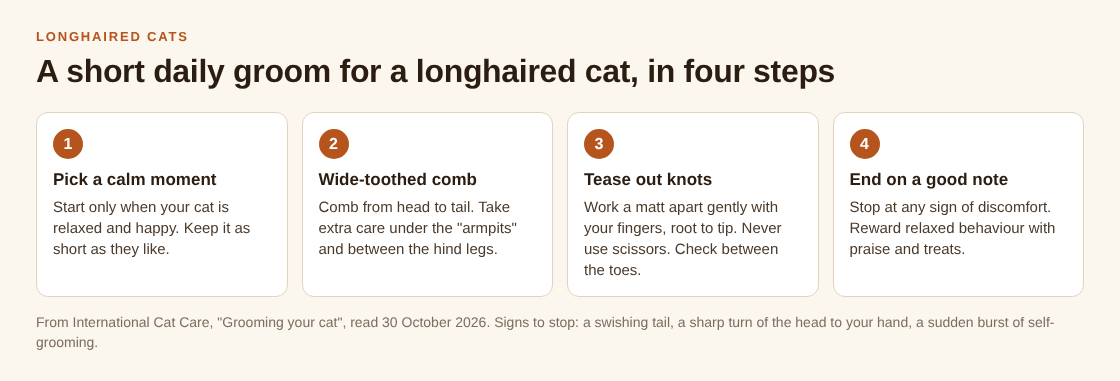
Here is a short daily groom, worked through from International Cat Care's steps:
- Pick a calm moment. Start only when your cat is relaxed and happy.
- Comb head to tail. Use a wide-toothed comb. Take extra care under the "armpits" and between the hind legs, where the skin is thin and knots are common.
- Tease out knots. Work a matt apart gently with your fingers, from the root to the end of the hair. Do not use scissors: it is hard to see where skin ends and hair starts, and you could cut your cat. Check between the toes and pads too.
- Watch for signs to stop. A swishing, thumping or twitching tail, a sharp turn of the head towards your hand, or a sudden burst of self-grooming mean your cat has had enough.
- End on a good note. Stop before your cat is uncomfortable, and reward relaxed behaviour with praise and a treat.
Cats Protection adds that grooming should use as little restraint as possible, a little at a time, and that a sudden change in how much your cat grooms itself is a reason to see your vet.
Frequently asked questions
Is a domestic longhair a breed?
No. PDSA says domestic longhairs are not a recognised breed. They are cats of mixed ancestry with a much longer coat.
How often should you brush a domestic longhair?
Daily. Cats Protection says a long-haired cat will need a daily brush, particularly if it goes outdoors, and International Cat Care says at least daily, for as long as the cat is comfortable.
How long do domestic longhair cats live?
PDSA gives an average lifespan of 12 to 15 years for domestic cats, as a general guide.
How is a domestic longhair different from a Persian or Maine Coon?
Those are recognized breeds, each with a written standard. A domestic longhair is any long-coated cat of mixed ancestry, so its body and face can take many forms.
Get started: log the fluffy cats you meet with Cat Go
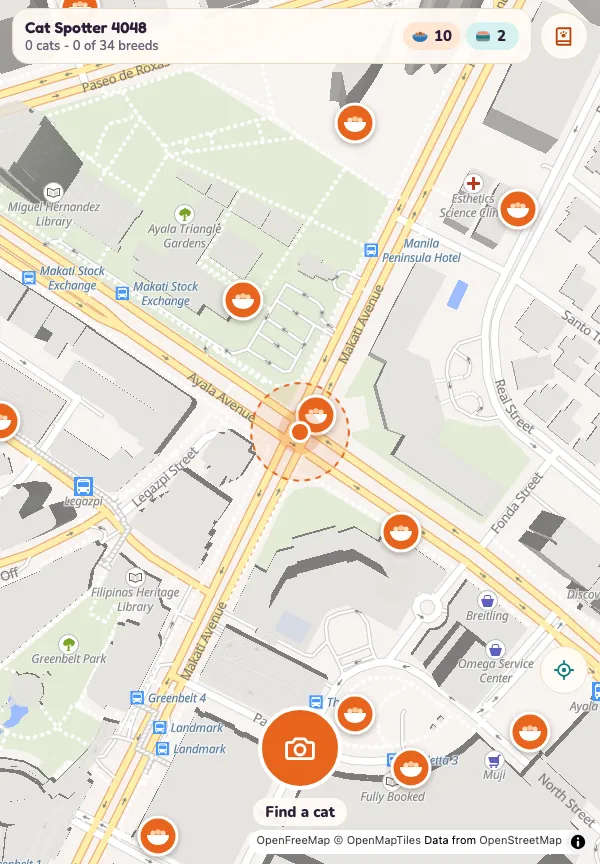
Cat Go turns a walk into a record of the cats you meet. Open it at catgo.vlvd.net and allow your camera and location. When you meet a real cat, take its photo with the whole cat in the frame. The game then asks "Which breed is it?" and you pick from a list of 34 breeds. For a long-coated cat with no known background, the game's own tip fits: "Mixed breed is always a safe pick."
Toss a few in-game treats to win the cat over, and it is saved to your Catdex with its breed and the place you met it.
Play Cat Go in your browser: walk anywhere, photograph a real cat, lure it with food and catch it.
Walk anywhere, find a real cat, and catch it.
Visit catgo.vlvd.net↗
Comments
No comments yet.