Wigmore Castle: the Mortimers and the Welsh March
Wigmore Castle stands on a long, narrow ridge in north Herefordshire, close to the border between England and Wales. English Heritage's history of Wigmore calls it a major centre of power for over 500 years, and for most of that time it was the home of the Mortimers, one of the strongest families on the Welsh March. This post follows the castle from its timber start to the overgrown ruin you can walk today.
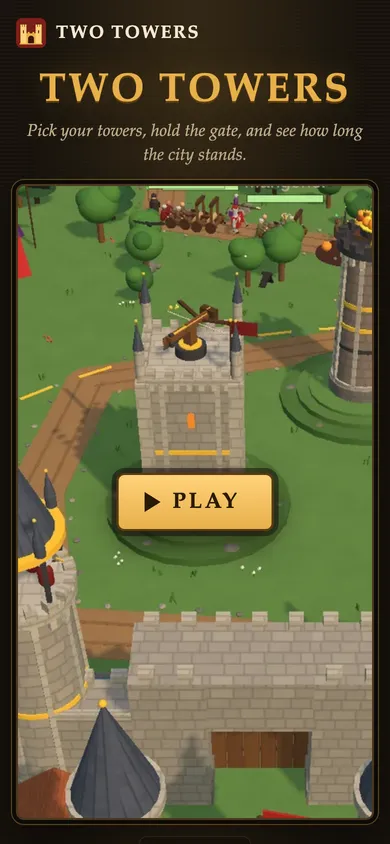
If you like the idea of a defence built in layers, Two Towers is a free tower defense game in your browser where you guard a city gate with two towers, then add towers on the hills as the attacks grow.
William fitz Osbern's border castle
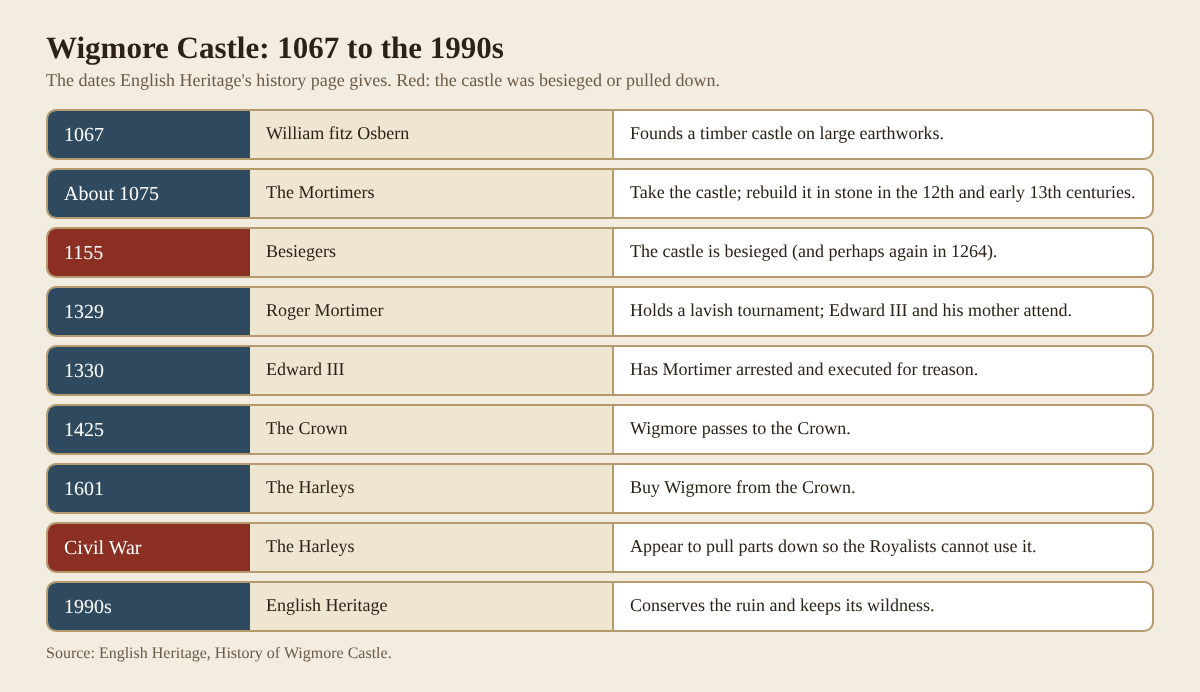
Wigmore was founded in 1067, the year after the Norman Conquest, by William fitz Osbern, Earl of Hereford and a close friend of William the Conqueror. It was one of a line of castles the Normans built near the border to defend England against attacks from Wales.
The first castle had strong timber walls on top of large earthworks, the same idea as other early Norman castles. Our post on the motte and bailey castle explains that design.
The Mortimers rebuild in stone
Fitz Osbern died in 1071, and by about 1075 the castle had passed to the Mortimer family. They held it until the early 15th century. In the 12th and early 13th centuries they rebuilt it in stone. The inner part of the gatehouse and the D-shaped east tower are the main parts left from that time.
Wigmore became the chief fortress from which the Mortimers controlled large parts of central Wales. It was their base for many raids into Wales, and it was besieged in 1155 and perhaps again in 1264.
Lords of the Welsh March had powers most English lords did not. English Heritage lists the right to make war, to hold their own courts, and to collect some revenues that elsewhere belonged only to the king. Clun, in Shropshire, was another marcher castle, and our Clun Castle post follows the Fitzalans who held it.
How Wigmore Castle was laid out
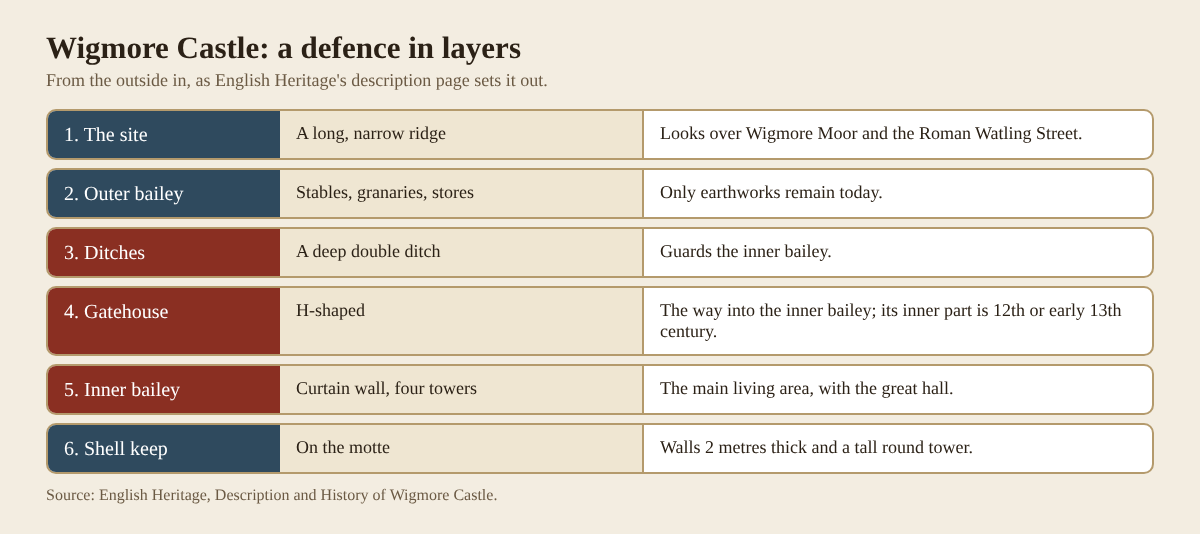
The description of Wigmore Castle shows a defence built in layers along the ridge. The site looks over Wigmore Moor and the Roman Watling Street, and deep ditches and strong walls made it harder still.
- The outer bailey held stables, granaries and stores. Only its earthworks remain.
- The inner bailey was the main living area. An H-shaped gatehouse, a deep double ditch and a curtain wall guarded it, and four of the wall's towers survive. One corner of the great hall still stands.
- The shell keep rose above it all on a motte, with walls 2 metres thick and a tall round tower.
Around the castle were deer parks, fishponds, a dovecot and a rabbit warren, and about a mile to the north was Wigmore Abbey, where the Mortimers were buried. Our posts on the castle gatehouse and moats and ditches explain why each layer mattered.
Roger Mortimer: from Wigmore to ruler of England
The best known of the family is Roger Mortimer, 1st Earl of March, who lived from 1287 to 1330. In the early 14th century he added towers at Wigmore with fine lodgings, fireplaces and window seats, and a large porch for the gatehouse.
He became, in effect, the ruler of England. With Isabella, the estranged wife of Edward II, he brought about the king's removal and murder in 1327. In 1329 he held a lavish tournament at Wigmore, and the young King Edward III and his mother came to it.
His power did not last. In 1330 Edward III took control, arrested Mortimer and had him executed for treason. The castle came back to the family later in the 14th century, but it never regained its old importance, and Ludlow seems to have become their main home. Later Mortimers still rose high: the 2nd Earl was a founder member of the Knights of the Garter, and the 4th Earl was briefly next in line to the throne. In 1425 Wigmore passed to the Crown.
The Civil War: pulled down by its own side
The Harley family bought Wigmore from the Crown in 1601. In the Civil War they were on Parliament's side, and they could not defend both Wigmore and their main home at Brampton Bryan. So they appear to have pulled down parts of Wigmore to stop the Royalists using it as a base.
Brampton Bryan had its own story. Brilliana Harley, wife of Sir Robert Harley, held it against a Royalist siege in the spring of 1643, but the house was destroyed after a second siege in 1644. Our posts on slighting a castle and Lady Blanche at Old Wardour follow the same years from other castles.
A glorious ruin
After the Civil War, Wigmore was left alone for centuries. That neglect kept the medieval castle remarkably undisturbed, and many of its walls are now buried several metres deep.
When English Heritage conserved it in the 1990s, it chose to keep the castle wild. Rare species had made it their home, including lesser horseshoe bats and wildflowers such as ploughman's spikenard. The grasses, ferns and flowers on top of the walls were lifted and put back as a soft cap that protects the stone from rain. Two digs also found that timber-framed buildings once ran all along the inside of the inner bailey.
A worked example: defend in layers, hold what you can
Wigmore gives two lessons. Its builders put layer after layer between an attacker and the keep. And in the Civil War the Harleys chose to hold one place well rather than two places badly. Two Towers rewards both. Here is a plan built from what the game says.
- The gate is your keep. Choose its two towers on the title screen from the Archer Tower, Trebuchet, Ballista and Fire Tower. If the gate falls, the game is over, so everything else protects it.
- Add an outer layer. The game's own line is: "Raise barricades to slow them down." Slowed attackers stay longer in reach of your towers, which is the whole point of an outer layer.
- Use the high ground. Wigmore sat on a ridge. A tower on West Hill or East Hill costs 150 gold for the first and 300 for the second, and the game says: "Mangonels throw stones from far off: a hill tower with Range reaches them."
- Do not spread your gold thin. Like the Harleys, pick what you can hold. The game's advice is: "Spend your gold on Damage between stages, and Reinforce the gate."
- Plan for the big day. Wigmore hosted kings and queens. In the game, "A king leads every fifth stage: Reinforce the gate before it and save gold for Damage."
Play a few stages, then look at which layer the attackers broke through, and put your next gold there.
Frequently asked questions
Who built Wigmore Castle?
William fitz Osbern, Earl of Hereford, founded it in 1067. The Mortimers held it from about 1075 and rebuilt it in stone in the 12th and early 13th centuries.
Why is Wigmore Castle famous?
It was the seat of the Mortimers, lords of the Welsh March. Roger Mortimer, who ruled England with Queen Isabella after 1327, held a tournament there in 1329 before his execution in 1330.
Why is Wigmore Castle a ruin?
In the Civil War the Harleys appear to have pulled down parts of it so the Royalists could not use it. Centuries of neglect followed, and English Heritage conserved it as a wild ruin in the 1990s.
What lives in the ruins of Wigmore Castle?
English Heritage names lesser horseshoe bats and wildflowers such as ploughman's spikenard. Plants on the walls were kept as a soft cap to protect the stone.
Get started
Wigmore held the March with ditches, gatehouse, walls and keep, one layer behind another. To build a defence of your own in layers, play Two Towers: choose two towers for the gate, add the hills and see how long it holds.
Defend the castle gate, stage after stage.
Visit twotowers.vlvd.net↗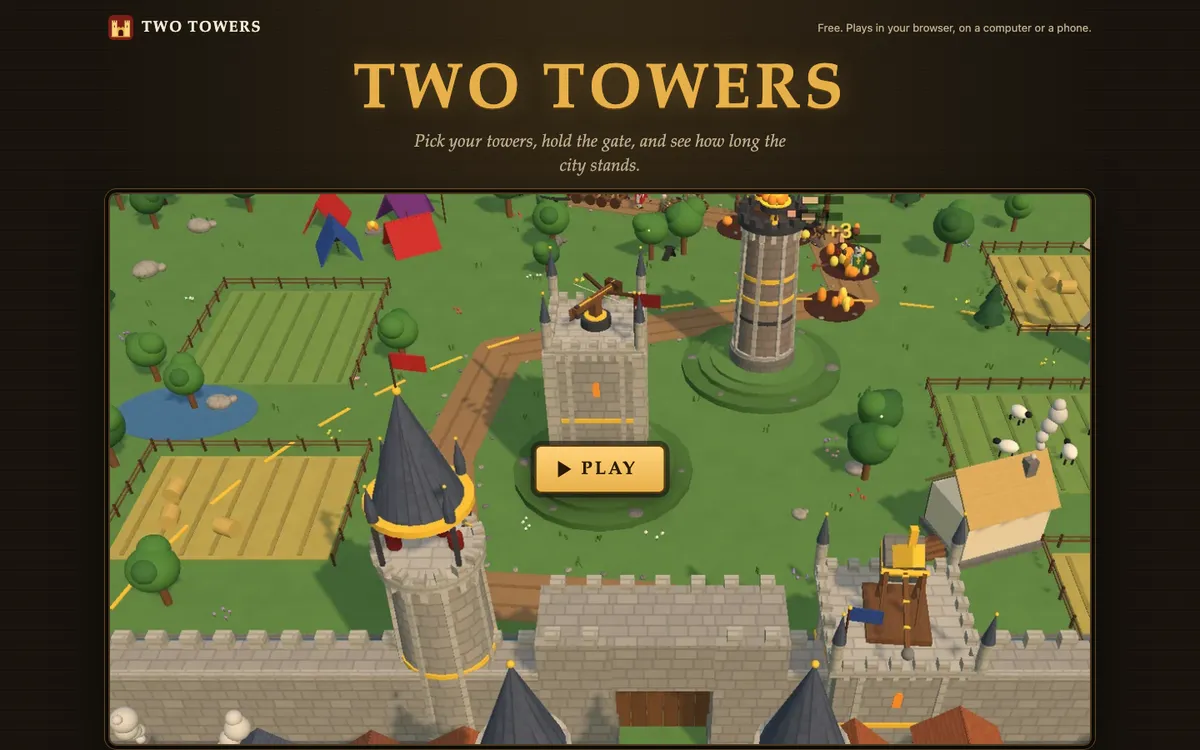
Comments
No comments yet.